Coworking for Modern Teams: Why Hybrid Work Needs Flexible Spaces

Coworking for Modern Teams: Why Hybrid Work Needs Flexible Spaces

Written by: Angeline Suriaatmaja

Last Update: 25 November, 2025Read: 10 minutes
The era of mandatory, five-day-a-week office attendance is over. Today, the Hybrid Work Model is not just a perk but a strategic bedrock for successful, modern organizations. Companies are trading rigid corporate leases for the flexibility and freedom that employees now demand.

But this shift presents a new challenge: How do you maintain team cohesion, adopt deep collaboration, and ensure equity between remote and in-office staff when your team is decentralized?

The answer lies in renting a Flexible Workspace.

This guide is built to elevate your hybrid strategy far beyond shared desks or simple coworking passes. We will move past surface-level perks (free coffee is excellent, but not a strategy) and focus on what truly matters:
  • Why coworking is a smarter cultural and financial investment than traditional offices
  • What to evaluate when selecting a space that supports productivity, equity, and collaboration
  • How to create an “in-office” playbook that turns onsite days into high-value rituals

The right coworking space becomes the anchor of your company culture and the hub of hybrid performance.

Let’s explore how to choose a coworking space, implement strategies, and tailor the work model to your team. Happy reading!

Why Does Your Hybrid Team Need Flexible Spaces?
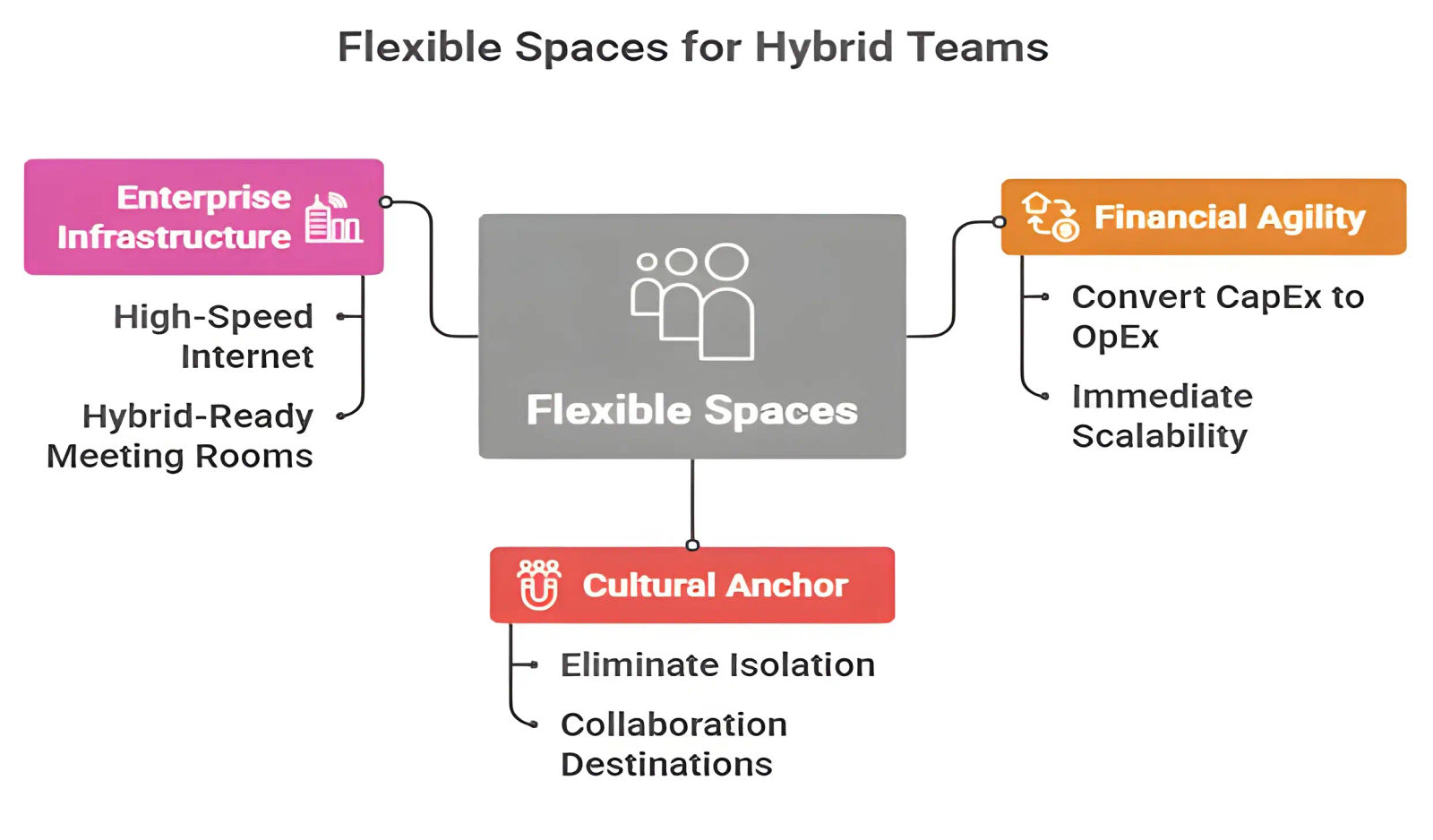
The shift to hybrid work created a powerful new paradox: employees demand flexibility, but they still need structure, connection, and professional infrastructure. The traditional office is too rigid to meet this new reality. Flexible coworking spaces step in to bridge this gap by solving hybrid work's most persistent problems.
Benefits of using flexible spaces for hybrid teams

1. Financial Agility and De-Risking Real Estate

The core need of the hybrid work model is cost-efficiency tied to variable usage. Coworking spaces provide this agility. They allow you to convert fixed capital costs (CapEx) for underutilized space into flexible operational expenses (OpEx), which is why companies are keen to understand the economic impact of coworking spaces and hybrid work models on businesses.

Here’s how it happens:
  • You convert fixed capital costs (CapEx) for underutilized space into flexible operational expenses (OpEx).
  • It offers immediate scalability, allowing you to shrink or expand your footprint month-to-month without the penalty of long-term leases, effectively de-risking real estate investment.

2. Cultural Anchor and Talent Retention

The downside to hybrid culture is social disconnection. Fortunately, coworking spaces are purpose-built to foster high-quality interaction.
  • They eliminate isolation and proximity bias by serving as neutral, third-party hubs superior to home offices.
  • They are destinations designed for collaboration, not just individual work, which is key to preserving team cohesion and attracting high-demand talent who value flexibility.

Since community engagement is a key pillar of hybrid success. Ready to turn casual connections into powerful business assets? Read the 10 Key Benefits of Business Networking in Coworking Spaces.

3. Enterprise Infrastructure and Reliability

Successful hybrid communication requires guaranteed technology that the home office often lacks. Flexible spaces provide enterprise-grade reliability from day one.
  • Coworking spaces offer SLA-backed, high-speed fiber internet with redundancy, eliminating connectivity failures that cripple hybrid meetings.
  • They provide hybrid-ready meeting rooms, professionally equipped with modern A/V technology optimized to ensure an equitable experience for both in-person and remote participants.

How to Select the Right Coworking Space for your Hybrid or Remote Team?

Securing a coworking space for your remote-hybrid team requires a strategic, not impulsive, decision. You are not just renting square footage; you are investing in an environment that must support your team's diverse needs, from deep focus to high-fidelity video conferencing.

This section provides a rigorous, step-by-step checklist to ensure the space you choose is a genuine asset rather than a temporary distraction.

1. Define Your Team's "Coworking Profile"

Before you start touring coworking spaces, you must define how your team will use the facility.
 

Question

Hot Desks / Flex (Lower Cost)

Private Office Suite (Higher Cost)

Primary Use?

Individual focus work, occasional casual meetings, and drop-ins.

Weekly "anchor days," secure client meetings, and high privacy needs.

Headcount and Frequency?

smaller


Privacy Needs?

Low to moderate. Phone booths are sufficient for calls.

High. Confidential calls, protected equipment, and constant branding are required.

Tally your team's needs. If your score leans heavily toward "high frequency" and "high privacy," a dedicated private office suite within a coworking layout will likely offer the best ROI.

2. The 'Must-Have' Technology and Infrastructure

The quality of the tech stack separates a great flex space from a frustrating one. This is non-negotiable for a successful hybrid team.

A. Connectivity Guarantee (The Most Critical Element)

Focus on robust, reliable internet infrastructure, as bandwidth failure cripples remote collaboration. Check for the following technology presence.
  • Internet Speed: Insist on a guaranteed Service Level Agreement (SLA) for upload and download speeds. Ask for evidence of fiber-optic connectivity, not just standard business broadband.
  • Redundancy: Does the center have a backup connection (e.g., secondary Internet Service Provider (ISP) or failover)? Downtime is catastrophic for remote collaboration.

How to run an inspection for technology and infrastructure?
  • Ask the Manager: "Can you show me the SLA document for your internet service?"
  • Run a Test: Perform a speed test during peak hours (e.g., 10 AM) to verify advertised speeds.
  • Check for Failover: Confirm the existence of a secondary ISP or mobile backup, and ask how quickly they switch over.

B. A/V for Hybrid Meetings

Meeting rooms must be equipped for "collaboration equity," ensuring that remote and on-site attendees have equal voice and visual access. Take the necessary steps presented below. 
  • Testing Meeting Rooms: Do they feature integrated video conferencing equipment (high-definition cameras, ceiling microphones, and easy screen sharing)?
  • Video Conferencing Compatibility
  • Video Conferencing Compatibility: Ensure the setup is platform-agnostic (works efficiently with Zoom, Teams, and Google Meet).

How to run an inspection for meeting room facilities?
  • Simulate a Meeting: Ask to enter a meeting room and try connecting your laptop to the A/V system (camera/mic/screen) to ensure it's simple and platform-agnostic.
  • Test the Mic: Clap once and walk to the back of the room to check if the microphone array captures clear audio throughout the space.

C. Secure Access and Printing

Protecting confidential company data and controlling physical access are paramount in a shared environment. Ensure the following queries are resolved. 
  • Access Security: Is access managed by secure digital keycards or apps?
  • Network and Document Security: Are printers and network access managed via secure, individualized sign-in to protect confidential documents?

How to run an inspection for secure access and printing utilities?
  • Observe Access: Note whether access points (doors, elevators) require a personalised keycard or a simple, easily copied code.
  • Verify Printing: Request a walkthrough of the printing process. It should require your team member to log in to the device with a unique ID or code before the document prints.

3. Evaluating Space Design for Hybrid Success

The physical layout must actively support the different work modes (focus, brainstorm, privacy) required by a modern team, moving beyond merely aesthetic appeal.

A. Acoustics and Privacy

Confirm the space is designed for quiet focus; a noisy, open area undermines the entire team's focus. Look for acoustically treated private offices and dedicated soundproof phone booths. Test the office acoustics yourself!

How to run an inspection for office acoustics and privacy?
  • Test the Booth: Step inside a phone booth and close the door. Call a colleague and check if their voice is clear and if the sound of the open space can be heard.
  • Walk the Space: Tour the facility during peak working hours (10 AM - 3 PM) to gauge the natural background noise level.

B. Zoning Strategy

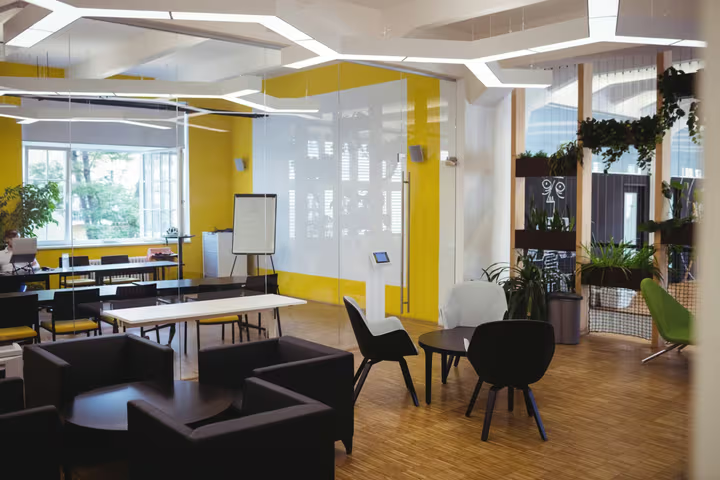
A well-designed space divides areas into clear zones:
  • Quiet Focus Zones: Areas where calls and talking are strictly prohibited.
  • Collaboration Zones: Open areas for brainstorming and casual interaction.
  • Meeting/Privacy Zones: Bookable rooms and phone booths.
  • Ergonomics: Evaluate office furniture, design, and seating arrangements.

How to run an inspection for area collaboration and zone distribution?
  • Look for Signage: Check for clear, visible signs labelling the "Quiet Zone" versus the "Collaboration Area." Clear labelling indicates management enforces the policy.
  • Trace the Path: See if the high-traffic path to the kitchen/restrooms cuts directly through the designated quiet work area.

If your flexible office lacks some of these features, you can always refer to our Top 7 Steps for Designing a People-Centric Workspace.

C. Ergonomics

Ensure furniture promotes health and sustained productivity. Your team deserves more than flimsy furniture. Check for:
  • Adjustable/Ergonomic Seating.
  • Height-Adjustable Desks (standing options).
  • Adequate Power Access at every workstation.
How to run an inspection for office ergonomics?
  • Sit Test: Try out the chairs in both the hot-desking area and the private offices. Look for quality, adjustable features (lumbar support, arm height).
  • Check Power: Note the accessibility and number of outlets near each desk or table.

Did you know that ergonomically designed offices contribute to talent acquisition and retention? Don’t believe us? Read more in our featured guide on How Furnished Office Spaces Attract Top Talent.

4. Understanding Membership and Terms (The Financial Deep Dive)

Flexibility is the core value of coworking, but be sure the contract reflects true cost savings and scalability without surprise fees.

A. The Break Clause

Confirm your ability to flexibly scale your commitment because the most significant advantage over a traditional lease is the ability to scale up or down quickly. Prioritize agreements with short-term commitments (month-to-month or 6-month) and clear clauses for adding or removing members.

How to read the agreement properly?
  • Request the Clause: Ask to see the specific section of the contract detailing termination or reduction of services, along with the required notice period (e.g., 30 days).

You can also review our helpful insights into the flex space agreement clauses to stay ahead and plan your investment and strategy effectively.

B. Tier Comparison

Match your team's consistency to the membership level by understanding the difference between a simple Day Pass (best for individuals) and a Dedicated Membership (best for consistent team use).

How to assess and understand workspace memberships?
  • Calculate ROI: Determine the average daily cost per employee for both the Day Pass and Dedicated Membership tiers based on your projected usage (e.g., 2 anchor days per week). Choose the most cost-effective option.

Related: Hot Desk vs. Dedicated Desk: Which Workspace is Best for Your Business?

C. Hidden Costs Audit

Review the contract thoroughly for:
  • Guest fees (if your team regularly hosts clients).
  • After-hours or weekend access charges.
  • Excessive fees for basic amenities such as printing or locker use.

How to review a contract thoroughly?
  • Demand a Full Price Sheet: Ask for a comprehensive list of all non-membership charges (e.g., printing overage, coffee refill service fees, administrative setup fees).
  • Negotiate: Always negotiate a fixed number of free printing credits or meeting room hours included in the base rate.

Want to learn more about the most popular flexible office spaces? Check out our guide on The Differences Between Coworking, Serviced, and Managed Offices, and which one to pick.

How can you Optimize Hybrid Team Success by Utilizing Coworking Spaces?
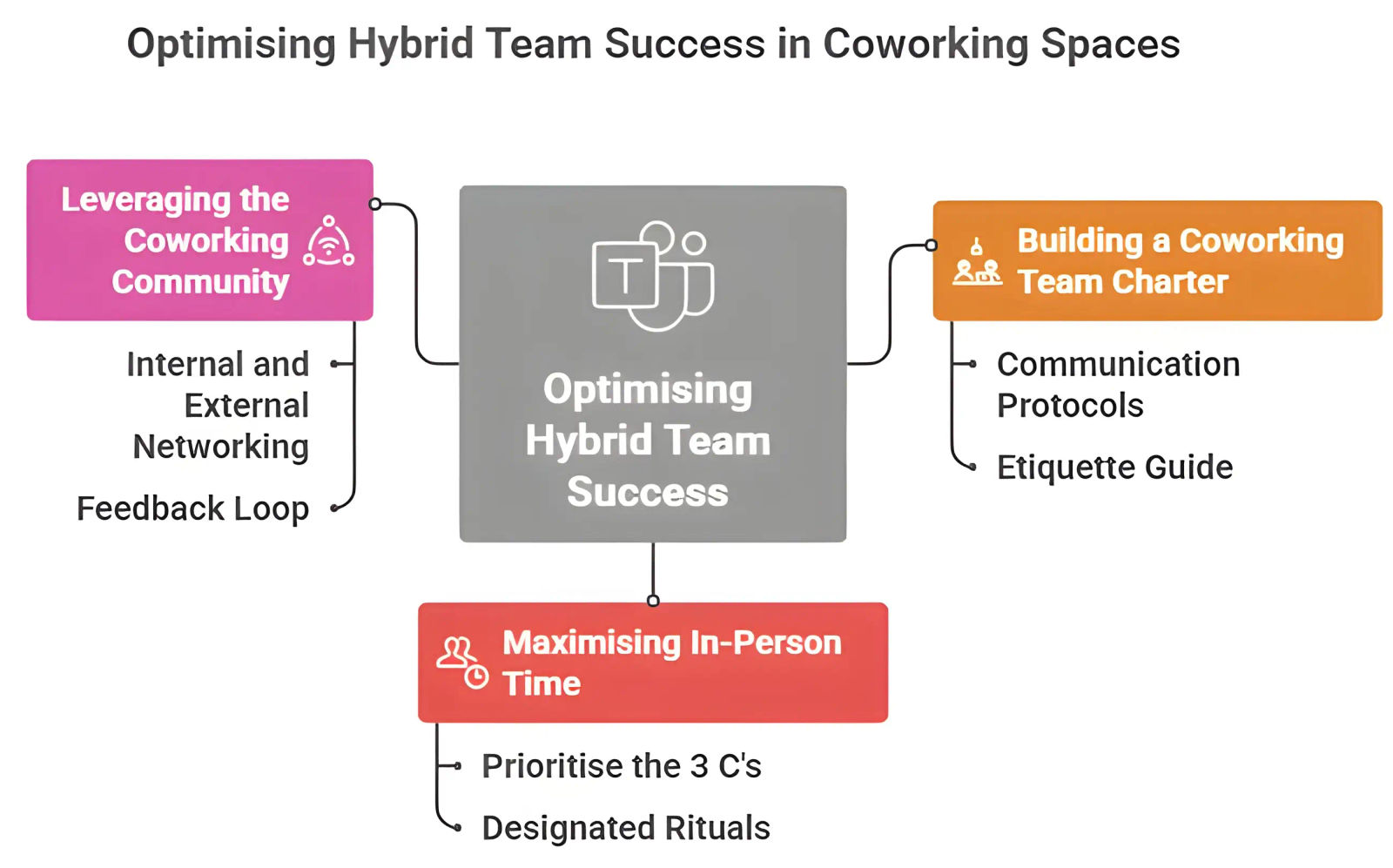
Securing the perfect physical space is only half the battle. The true success of hybrid work hinges on how your team utilizes that space. The "Coworking Playbook" featured below provides the cultural and managerial guidelines necessary to maximize productivity, cohesion, and value from your flexible workspace investment.
3 Ways to Optimise Hybrid Team Success by Utilising Coworking Spaces

1. Building a Coworking Team Charter

The shared environment requires shared rules. A Team Charter sets clear expectations for behavior, communication, and usage.

A. Define Core Communication Protocols

Establish clear rules for when to use digital tools versus in-person interaction to avoid confusion and distraction.

The guidelines for the communication protocol include:
  • Communication Protocols: When is it appropriate to use Slack/Email (for quick updates), in person (for brainstorming/coaching), or a phone booth (for private calls)?
  • In-Office Days Policy: Clearly define "anchor days" for team collaboration to ensure critical mass for high-value meetings.

Instructions for Inspection are present below:
  • Collaborative Draft: Create the charter's first draft collaboratively with team leaders.
  • Mandatory Review: Make the charter a compulsory element of the onboarding process for all new hires.

B. Etiquette Guide

Ensure team members respect the facility's shared nature and the focus required by others.

See the instructions below.
  • Respecting the Shared Space: Establish rules for noise levels, keeping common areas clean (especially kitchens/hot desks), and managing personal belongings.
  • Guest Policy: Define procedures for registering guests or clients to ensure compliance with the coworking center's rules.

Instructions for Inspection are present below:
  • Visual Reminders: Use digital screens or printed posters in the office suite to display the top three etiquette rules (e.g., "Phone calls must be taken in a booth").

Struggling with team bonding in your hybrid-coworking office model? Read our proven Effective Strategies for Teamwork in Workplaces for a seamless collaboration, boosted team morale, and bonding experience.

2. Maximizing In-Person Time for High-Value Activities

Do not commute just to join a Zoom meeting alone. In-office days must be intentional, focused on connection and strategic work.

A. Prioritize the 3 C's

Anchor days must be reserved for activities that benefit most from face-to-face interaction. This will help to:
  • Prioritize workspace collaboration (brainstorms, problem-solving workshops), culture (team lunches, social hours), and coaching (1:1s, mentorship) for in-office days.
  • Avoid individual focus work or administrative tasks that could be done effectively at home.

Instructions for Inspection are present below:
  • Calendar Blocking: Encourage managers to title their anchor day "Collaboration Day" and to schedule high-impact group activities.
  • No "Silent Zoom" Zones: Discourage employees from sitting in the office to join meetings where all other attendees are remote—that is the definition of a wasted commute.

B. Designated Rituals

Use the space's amenities to promote employee engagement that boosts morale, workplace experience, and productivity and efficiency.

You can achieve it in the following ways:
  • Make Team Rituals: Utilize the space for team lunches, celebratory events, training workshops, and informal "coffee roulette" pairings.
  • Adopt Managerial Best Practices: Leaders must lead by example, actively engaging with team members and using the collaboration zones.

Instructions for Inspection are present below:
  • Budget Allocation: Allocate a specific monthly budget to use the coworking facility’s kitchen/event spaces for team meals or happy hours.

3. Leveraging the Coworking Community

Your team is not just renting space; it is joining an ecosystem rich with networking opportunities.

A. Internal and External Networking

Encourage your employees to look beyond their own team for innovation and knowledge sharing. See below.
  • Community Engagement: Connecting with other member companies can spur innovation, knowledge sharing, and even lead to business partnerships.
  • Events and Workshops: Use the space's programming (e.g., lunch-and-learns, industry meetups) to foster team development and social bonding outside your company bubble.

Instructions for Inspection are present below:
  • Assign an Ambassador: Designate one enthusiastic team member as the "Coworking Ambassador" responsible for monitoring community boards and communicating relevant events to the team.

B. Feedback Loop

Establish a simple process for continuous improvement and effective facility management. Follow the guidelines below:
  • Reporting Issues: Establish a process for team members to quickly report facility issues (e.g., broken A/V equipment, connectivity problems) to the coworking management.
  • Amenity Requests: Provide a channel for team members to suggest new amenities or improvements to the space.

Instructions for Inspection are present below:
  • Dedicated Channel: Create a dedicated, private office channel (e.g., #office-feedback in Slack) for immediate issue reporting, ensuring problems are resolved before the next anchor day.

Simple suggestions aren’t enough. Read our practical guide on How Communities Come Together in Coworking Spaces to transform your flexible space into a genuine hub for powerful collaboration and opportunity.

Rent Coworking Spaces Now with Office Hub

The shift to hybrid work demands flexibility, resilience, and intentional spaces. Stop settling for traditional leases that drain your budget and fail your remote teams.

A flexible coworking space is your strategic advantage. By using it, you gain the technological reliability, cultural anchor, and financial agility needed to thrive in the new economy.
Ready to find your team's ideal collaborative workspace for hybrid work?

Partner with Office Hub! As the leading platform for flexible office solutions, we make it simple to match your team’s specified coworking profile with thousands of vetted spaces worldwide.

Contact us now to browse flexible office suites and start your search for the perfect hybrid HQ!

Frequently Asked Questions (FAQs)

On the contrary, flexible workspaces improve team culture by making in-person interactions intentional and high-value. They allow teams to prioritize collaboration and social activities during anchor days, increasing engagement and appreciation for the time spent together.
Collaboration equity is ensured by selecting a flexible workspace with hybrid-ready meeting rooms. These spaces must include integrated A/V technology (cameras, microphones) to ensure remote team members have an equal voice and visual presence with their in-person colleagues.
Yes. High-quality coworking spaces typically offer superior security by providing managed, secure Wi-Fi networks and secure printing solutions that require individualized sign-in. This mitigates the risks associated with unsecured home networks.
The essential technological "must-haves" are a guaranteed Service Level Agreement (SLA) for high-speed fiber internet with redundancy (backup connection), and meeting rooms pre-equipped with high-definition video conferencing hardware.
In high-demand markets, it is recommended that hybrid teams book key meeting rooms for their "anchor days" at least one week in advance. This guarantees availability for high-value collaborative sessions during peak times.
Absolutely. Coworking allows companies to convert the high, fixed capital expenditure (CapEx) of a traditional office into flexible operational expenditure (OpEx). This allows the company to pay only for the space it actually uses, directly reducing overhead costs.
Small, distributed remote teams often benefit most from a combination of memberships: a Dedicated Office Suite for core team meetings and Hot Desk Day Passes for individual employees who need local drop-in access closer to their homes.

You can read more about these memberships in a comparative guide on Hot Desks vs. Dedicated Desks: Which One is Right for Your Business.
An effective zoning strategy (e.g., separating "Quiet Focus Zones" from "Collaboration Zones") is critical. It ensures team members have acoustically protected areas for concentration while also having dedicated spaces for dynamic, noisy brainstorming sessions.
A Coworking Team Charter is a set of guidelines that define team etiquette, communication protocols, and meeting room usage. Hybrid teams need it to ensure respect for the shared space and to maximise the effectiveness of precious in-person time.
The "Break Clause" is the biggest financial benefit, allowing you to terminate or adjust your membership with short notice, typically 30 to 60 days. This means you can quickly scale down costs if your team size or needs change without being locked into a long, expensive lease.
Angeline Suriaatmaja
ABOUT THE AUTHOR
Angeline Suriaatmaja
Angeline Suriaatmaja is a high-spirited expert who ensures a smooth transition for new clients, partners, or employees. She offers invaluable guidance at every step, crafting seamless experiences that lay the foundation for long-term, thriving partnerships and success.

We are Australia's No. 1 marketplace for serviced, coworking, and shared office space.

Connect with our local experts for flexible workspace solutions across Australia. Get personalized recommendations, arrange tours, and secure the best deals — all at no cost.


Office Hub team memberOffice Hub team memberOffice Hub team memberOffice Hub team member

Talk to our Experts directly

1300 770 200

Latest News

Explore trends, data, and tips shaping Australia’s dynamic office market

Breaking New Ground: Inventory Integrations That Change Everything

Breaking New Ground: Inventory Integrations That Change Everything

In the flexible workspace game, speed and accuracy matter. Outdated listings, incorrect availability, and manual updates don’t just slow you... Read more
Rebecca Philipp11 May, 2026
Pricing Guide for Office Spaces in Australia 2026

Pricing Guide for Office Spaces in Australia 2026

When planning to rent an office space in Australia, the first question most businesses ask is: How much does office space cost in Australia?... Read more
Rick Kamikura16 March, 2026
Managed vs Traditional Office Spaces in Australia: Which One is Right for Your Business

Managed vs Traditional Office Spaces in Australia: Which One is Right for Your Business

Traditional and managed office spaces are popular and viable options that Australian businesses consider to run their operations. However, t... Read more
Rick Kamikura27 February, 2026
Office Hub Launches First Strategic Partnership in the Netherlands, Marking a Major Milestone in Global Expansion

Office Hub Launches First Strategic Partnership in the Netherlands, Marking a Major Milestone in Global Expansion

Office Hub, the global flexible workspace advisory and technology platform, today announced the launch of its first licensed market in the N... Read more
Rebecca Philipp13 January, 2026
A Guide to Employee-Centric Flexible Office Amenities That Actually Matter

A Guide to Employee-Centric Flexible Office Amenities That Actually Matter

The office is no longer just a place to execute tasks; it is a powerful tool for recruiting, retention, and performance. According to WOW Re... Read more
Andrew Beck8 January, 2026
Coworking Space Cost in Australia: A Comprehensive Guide (2026)

Coworking Space Cost in Australia: A Comprehensive Guide (2026)

Coworking spaces have become a popular choice for businesses in Australia, offering numerous advantages such as flexibility, cost-efficiency... Read more
Rebecca Philipp7 January, 2026
Short-Term vs. Long-Term Office Leases: Which One is Better for Your Business?

Short-Term vs. Long-Term Office Leases: Which One is Better for Your Business?

Selecting the right lease term has become a crucial element of modern business. It is not only about getting a workspace anymore; it is abou... Read more
Andrew Beck6 January, 2026
Handling Shared Space Operations: A Guide for Multi-Tenant Management

Handling Shared Space Operations: A Guide for Multi-Tenant Management

Managing a shared workspace is about creating an environment where every tenant feels valued, productive, and supported. When operations run... Read more
Andrew Beck6 January, 2026
How to Make Your Space Eco-Ready and Marketable for Tenants

How to Make Your Space Eco-Ready and Marketable for Tenants

Sustainability is no longer a niche trend in commercial real estate; it is a core expectation for tenants and investors alike. An eco-ready ... Read more
Angeline Suriaatmaja6 January, 2026
What is an Office Pod and How Can It Improve Privacy?

What is an Office Pod and How Can It Improve Privacy?

In the modern Australian workplace, where open-plan layouts dominate from Sydney’s CBD to Brisbane’s tech hubs, a common challenge has emerg... Read more
Miles Anderson5 January, 2026
The Future of Flexible Workspaces: Insights for Space Providers

The Future of Flexible Workspaces: Insights for Space Providers

The flexible workspace industry stands at a critical juncture. The shift to permanent hybrid models is a foundational change driving global ... Read more
Angeline Suriaatmaja12 December, 2025
The Importance of Flexible Lease Terms for Attracting Modern Tenants

The Importance of Flexible Lease Terms for Attracting Modern Tenants

The rental market has fundamentally changed. Today's tenants, driven by dynamic careers and lifestyle needs, are no longer content with ... Read more
Rebecca Philipp12 December, 2025
How to Price Your Office Space Competitively

How to Price Your Office Space Competitively

Setting a market-aligned price for your flexible office space is a critical, ongoing strategic decision. The core goal for every property pr... Read more
Angeline Suriaatmaja11 December, 2025
Is a Flexible Office Right for You? Financial Factors to Consider

Is a Flexible Office Right for You? Financial Factors to Consider

Australian businesses are navigating a workplace revolution. With hybrid work becoming the norm, teams expanding or contracting quickly, and... Read more
Daniel Lange10 December, 2025
Designing Your Perfect Workspace: Layout Tips for Productivity and Culture

Designing Your Perfect Workspace: Layout Tips for Productivity and Culture

Congratulations ! Moving into a new office is a significant milestone for any growing startup. Now that the boxes are unpacked and the WiFi ... Read more
Daniel Lange2 December, 2025