How to Choose the Right Office Space for Your Business
Last Update: 19 November, 2025•Read: 10 minutes
Choosing the ideal office space involves balancing your team’s needs with budget, location, lease terms and company culture. Nearly 55% of global occupiers use flexible offices, with 17% planning to adopt more, and analysts predict that 30% of all office space will be “flexible” by 2030.
Considering the surge in demand, popularity, and positive reviews for flexible spaces, it’s a perfect time to secure the space that drives your growth. Your office now influences more than just where people sit. It affects:
But with so many options, coworking, private, serviced, enterprise, and sublets, how do you figure out what your business actually needs?
This guide breaks it down simply:
You’ll learn the types of flexible offices, the six factors that matter most, get a ready-to-use checklist, and a quick quiz to help you pick the right space.
Let’s get started.
Considering the surge in demand, popularity, and positive reviews for flexible spaces, it’s a perfect time to secure the space that drives your growth. Your office now influences more than just where people sit. It affects:
- Productivity
- Culture
- Hiring
- Client perception
- Long-term operational costs
But with so many options, coworking, private, serviced, enterprise, and sublets, how do you figure out what your business actually needs?
This guide breaks it down simply:
You’ll learn the types of flexible offices, the six factors that matter most, get a ready-to-use checklist, and a quick quiz to help you pick the right space.
Let’s get started.
Types of Flexible Office Space
1. Communal and Collaborative Solutions
2. Dedicated and Professionally Managed Solutions
3. Strategic and Temporary Solutions
Summarising the Flexible Office Face-Off
6 Key Factors to Consider for Renting Flexible Offices
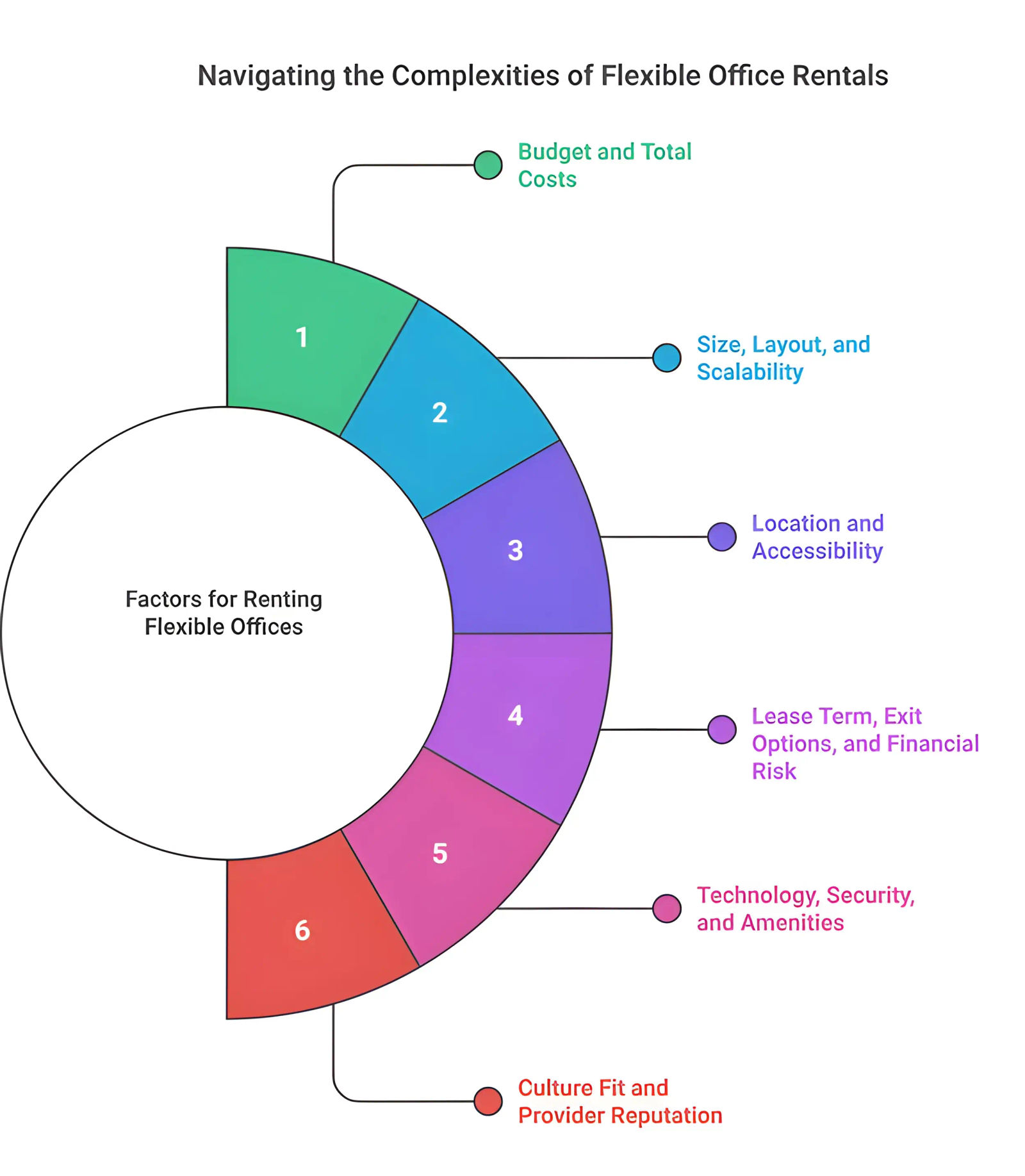
1. Budget and Total Costs
2. Size, Layout, and Scalability
3. Location and Accessibility
4. Lease Term, Exit Options, and Financial Risk
5. Technology, Security, and Amenities
6. Culture Fit and Provider Reputation
Flexible Office Space Checklist: The Must-Haves!
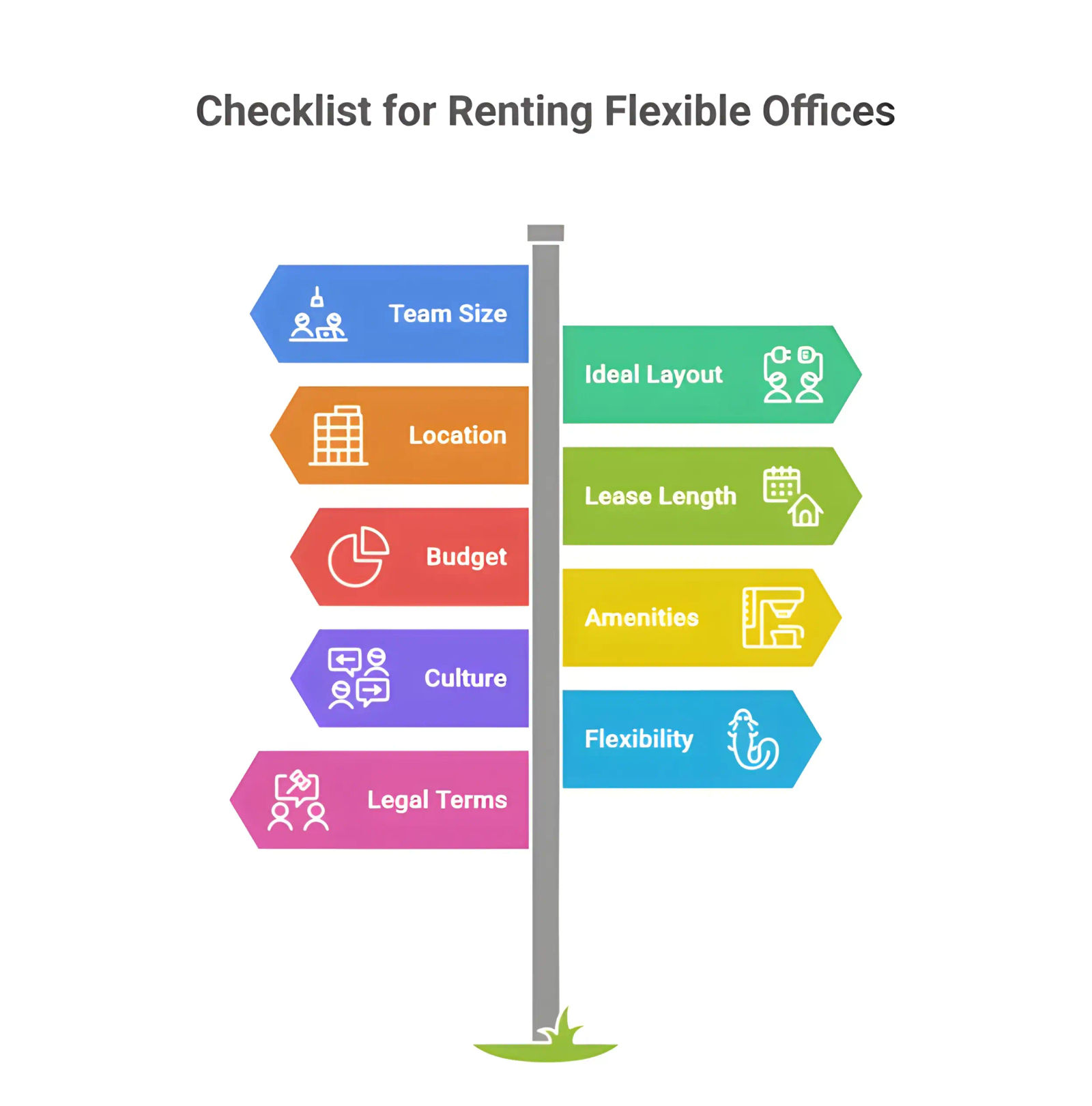
Team Size and Space Needs
The Ideal Flexible Layout
Location and Commuting
Lease Length
Budget and Extras
Amenities and Tech
Culture and Community
Flexibility and Notice Periods
Legal Terms and Responsibilities
Ready for a FlexSpace Trivia?
Start
End Results:
Space Type Brief: What Did You Pick?
The Final Move: Secure Your Strategic Space with Office Hub
Frequently Asked Questions (FAQs)
Coworking is ideal if your team values networking, extreme flexibility, and a lower upfront cost, often providing a strong community feel. A private or serviced office is better if you require higher confidentiality, want specific branding control, or need a consistently quieter work environment.
A serviced office is typically a fully furnished, plug-and-play space where the provider handles all utilities, furniture, and administrative support. A managed office is a broader term that often refers to a larger suite or whole floor that can be custom-branded, with the provider managing the lease and operations for the tenant.
For a better understanding of both space types, read the comparative guide to a serviced, managed, and traditional office lease.
For a better understanding of both space types, read the comparative guide to a serviced, managed, and traditional office lease.
Definitely, the flexible model has evolved to serve large corporations. Enterprise suites are private, custom-branded floors designed for teams of 50+ employees. They offer exclusive amenities while maintaining the agility of a short- to mid-term lease (1–5 years), making them popular for rapid scaling or project-based teams.
Yes. Subletting offers private space at the lowest cost because you are renting from another tenant rather than a major provider. They are perfect for early-stage teams that need privacy and a short-term commitment, often for 3 to 6 months, outside a major center's standard contract.
Always ask for a detailed breakdown of what is excluded from the headline price. While flexible offices are usually all-inclusive, look out for extra fee factors, such as charges for meeting room use beyond a monthly credit, overages for high-volume printing, and after-hours HVAC/AC surcharges. Always compare the actual total operational cost per desk to avoid budget surprises.
The average cost per desk for a flexible office space in prime locations like Midtown Manhattan or London's City Center ranges from $450 to $850 per month, while a private office can cost $700 to $1,200+ per desk per month. Costs vary significantly by location, office type, and prestige.
For better insight into global property analytics and price quotations, we recommend visiting Office Hub’s Co-Stats tool. It offers real-time, localized pricing to help you make better decisions.
For better insight into global property analytics and price quotations, we recommend visiting Office Hub’s Co-Stats tool. It offers real-time, localized pricing to help you make better decisions.
A short-term lease lets you rent space for up to 6 months, sometimes month-to-month, with minimal commitment. It is perfect for startups or projects where your needs may change quickly. While the monthly rate is higher, its stability is ideal for mitigating financial risk during periods of uncertain growth.
With a conventional lease, moving in can take 3 to 6 months due to negotiations, legal checks, and fit-out construction. Conversely, flexible offices, serviced or coworking layouts, are often plug-and-play, allowing you to sign a contract and move in within 24 hours to 1 week when rented via Office Hub. This agility is essential for fast-scaling or project-based teams.
Standard amenities in flexible offices include fast internet, meeting rooms, professional reception, secure access and surveillance, regular maintenance, and access to communal spaces like kitchens, lounges, and breakout areas. Premium spaces may offer high-value perks like gyms, wellness rooms, pet-friendly zones, free meals and beverages, or backup internet redundancy. Always confirm which specific amenities are included in your rent versus those billed separately.
Yes, absolutely. A virtual office provides a legal, professional, and prestigious mailing address for company registration, mail handling, and client correspondence. This is essential for creating a professional presence in a new city, for example, establishing a Sydney or Singapore address without the high capital commitment of a physical lease.
To find local flexible offices, use search queries like "best flexible offices near me" or visit a broker site like Office Hub. Our platform lets you search for flexible coworking, private, and serviced offices worldwide, filtering by city, desk count, lease length, amenities, and real-time prices.
As a leading platform, Office Hub offers access to a broader inventory, including off-market listings, across all global locations. We negotiate the best commercial terms, often securing a lower monthly rate, stronger incentives, or reduced deposits than you would if you approached the provider directly. Also, our office space browsing and touring service, price quotations, and consultations with local experts are available at no cost.

We are the UK's No. 1 marketplace for serviced, coworking, and shared office space.
Connect with our local experts for flexible workspace solutions across the UK. Get personalized recommendations, arrange tours, and secure the best deals — all at no cost.