News & Insights on Flexible Office Spaces in Singapore
LEARNING LAB
Tenant Hub
See more tenant guides
Short-Term vs. Long-Term Office Leases: Which One is Better for Your Business?
Selecting the right lease term has become a crucial element of modern business. It is not only about getting a workspace anymore; it is about shaping how your company works, grows, and reacts to change.
As the world and regional markets shift, many business centers have adopted flexible work structures. Understanding how lease terms affect your adaptability, finances, and workforce experience is more important than ever.
In today’s landscape, a lease isn’t merely a contract; it's a strategic tool. Your lease length influences:
- How quickly your business can grow
- Efficiency in daily operation
- Collaboration and styles of the culture
- The cash flow and cost control are in the long run
- Employee contentment and retention
- Continuity planning and risk management
Yet, with an expanding mix of options from short-term leases, long-term commitments, and hybrid agreements, it’s easy to feel uncertain about which model actually supports your goals.
In this guide, you will learn how short and long leases differ, the business scenarios where each one shines, the financial and operational trade-offs to consider, and a comparison checklist to help you make the right decision.
Let’s dive inRead more

How to Negotiate the Best Deal on Your Next Office Space
What if a few well-planned negotiation tips could significantly reduce your costs and give your business more flexibility?
Negotiating your next office space is more than signing a contract; it’s a strategic decision that can influence your company’s growth, operational efficiency, and financial health. Every clause, every dollar saved, and every flexible term affects how your team collaborates, estimated scalability, and daily operations.
In competitive business markets, understanding the nuances of lease negotiations is essential to turning your workspace into a true asset rather than a liability.
In this guide, we will walk you through actionable office lease negotiation tips, explore practical ways to rent an office more cheaply, and explain how to approach negotiations strategically to secure terms that align with both current needs and long-term growth.
You’ll also see how platforms like Office Hub provide market insights, comparisons, and expert guidance to help you make informed decisions with confidence. Dive in!

The Ultimate Office Relocation Checklist
Relocating an office demands time and resources, but a well-executed plan can guarantee an efficient, stress-free move that stays within budget. Office relocation is a frequent event; according to MoveBuddha, corporate moves account for 38% of annual relocations, small businesses for 44%, the military for 16%, and government agencies for 2%.
For considering a new change, the team has two primary reasons:
- The team has expanded beyond its current capacity.
- A move to a hybrid model makes a smaller office a more sensible choice.
This guide simplifies the process:
It covers the most critical reasons for relocation, and the different types of flexible offices that meet your needs. It includes a ready-to-use checklist to help you easily relocate your office space.
Let's begin.Read more

How to Choose the Right Office Space for Your Business
Choosing the ideal office space involves balancing your team’s needs with budget, location, lease terms and company culture. Nearly 55% of global occupiers use flexible offices, with 17% planning to adopt more, and analysts predict that 30% of all office space will be “flexible” by 2030.
Considering the surge in demand, popularity, and positive reviews for flexible spaces, it’s a perfect time to secure the space that drives your growth. Your office now influences more than just where people sit. It affects:
- Productivity
- Culture
- Hiring
- Client perception
- Long-term operational costs
But with so many options, coworking, private, serviced, enterprise, and sublets, how do you figure out what your business actually needs?
This guide breaks it down simply:
You’ll learn the types of flexible offices, the six factors that matter most, get a ready-to-use checklist, and a quick quiz to help you pick the right space.
Let’s get started.Read more

Top 5 Tech-Savvy Enterprise Space Providers Offering Corporate Office Solutions in Singapore
Today, modern enterprises demand more than just four walls and desks; they need smart, connected, and flexible environments that empower innovation and productivity. As Singapore cements its status as a global business hub, the demand for tech-savvy enterprise office spaces has grown exponentially. Companies are seeking dynamic workspaces equipped with cutting-edge technology, premium amenities, and flexible lease options that can adapt to their growth and operational needs.
From AI-integrated environments to fully serviced offices that eliminate the hassle of long-term leases, Singapore’s top office providers are redefining the way businesses operate.
In this blog, we have highlighted five tech-savvy enterprise space providers offering corporate office solutions in Singapore, each known for innovation, functionality, and the ability to create inspiring environments for forward-thinking companies.

The Ultimate Guide to Coworking Day Passes in Singapore: Costs, Locations, and How to Book
If you have ever wondered how much coworking day passes in Singapore cost, where to get them, and how to book them, this guide explains it all. We’ll walk you through what a coworking day pass is, its significance and benefits, payment policies, and where and how to easily secure one. Dive in.
Read more
The Ideal Office Space Per Employee in Singapore: A Strategic Guide to Boosting
What if your office layout could boost productivity, improve employee well-being, and even help you retain top talent without increasing your square footage?
In Singapore’s dynamic business environment, the way you plan and allocate office space can be a silent driver of success or a hidden cost draining morale and efficiency. The days of cubicle farms and rigid floor plans are gone. Today, the smartest companies are reevaluating the amount of space each employee truly requires, especially with hybrid work, wellness initiatives, and flexible seating becoming the new norm.
This blog examines the ideal office space allocation per employee in Singapore, why it matters more than ever, and how to achieve it to fuel growth and engagement in the modern workplace.

What is a Virtual Office and How Does it Differ from a Virtual Assistant?
The modern work environment has undergone a significant transformation, and physical office arrangements are no longer the sole choice. Today, both startups and multinational companies are adopting digital-first solutions that enable them to save money while maintaining a professional image.
Amidst this evolution, two terms have emerged: virtual office and virtual assistant.
- A virtual office offers a professional presence without the overhead of a physical space.
- A virtual assistant provides administrative support, freeing up time for core business activities.
While both provide flexibility and cost savings, and are often confused, their core functions are distinct. To help you figure out the difference, this blog explores the virtual office vs. virtual assistant comparison in detail. It further outlines their respective benefits and aims to help you determine the best solution for your business strategy or how to integrate both services effectively.Read more

Hot Desking vs Virtual Office: How to Choose a Flexible Work Solution that Works for You?
The dynamic nature of the current business world has made flexibility in offices not only a buzzword but a requirement. According to a 2023 report by Deloitte, more than three-quarters of enterprises are adopting a proactive approach to hybrid and remote working solutions as a cost-cutting measure and a means to boost productivity. This has resulted in the emergence of two trending choices: hot desking vs. virtual office.
Since both solutions are flexible and cost-effective, which one is exactly perfect for your business in Singapore and why? Let’s find out in this comparative guide.

Coworking vs WFH: Why a Hot Desk is Better for Freelancers?
The coworking vs WFH debate has been on the rise now that more freelancers are embracing flexible working arrangements. Although working at home is convenient, it is not always structured, networked, and there is no clear separation between work and personal life.
Hot desks are favoured as coworking spaces since they offer freelancers an inexpensive yet professional option. They are not only productive but also make people be creative, collaborate, and balance their work and life.
So, which setup is better for you and why? Let’s discuss this in this blog!
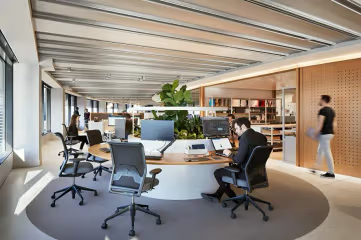
Hot Desking in Singapore: Your Ultimate Guide to Flexible Coworking Spaces
Our working dynamics are changing. Hot desking in flexible offices is becoming increasingly common, replacing traditional offices with fixed desks that are less adaptable to modern lifestyles.
Hot Desking in Singapore is one such trend which has become a game-changer for freelancers, startups and even established firms in Singapore. The idea integrates flexibility, teamwork, and economic benefits, making it attractive across a busy business centre like Singapore.
This guide will help you learn what hot desking is, how it can benefit you and your organisation, its associated costs, and where the best places to use it in Singapore are.
What You’ll Learn in This Guide
- What is Hot Desking in Singapore
- Why Hot Desking is Booming in Singapore
- Top benefits of Hot Desking in Singapore
- Cost of Hot Desking in Singapore
- Popular Locations for Hot Desking in Singapore
- Tips to Make the Most of Hot Desking

Finding the Perfect Fit: How to Choose an Office Space in Singapore?
Securing the right office space in Singapore is a significant milestone for any company looking to expand or establish an office. Singapore is a rapidly growing economy and a highly interconnected country; yet, renting office space in Singapore requires a well-thought-out plan. Every aspect is essential, including location, cost, amenities, and scalability.
In this guide, you will learn how to choose an office space in Singapore, considering your business requirements and future needs. Dive into it!
What You’ll Explore in this Guide:
- Understand your business needs first
- Prioritise the location of your workspace
- Evaluate the costs beyond rent
- Space planning and layout design
- Amenities and infrastructure
- Legal and regulatory compliance
- Measure scalability for future growth
- Use market insights for better decisions
- Internal and external connectivity
Host Hub
See more host guides
Handling Shared Space Operations: A Guide for Multi-Tenant Management
Managing a shared workspace is about creating an environment where every tenant feels valued, productive, and supported. When operations run smoothly, coworking and hybrid setups become vibrant communities that attract and retain clients. But when management falls short, even the most beautifully designed space can lose its appeal.
As Woody Williams wisely said, “No matter how good the team or how efficient the methodology, if we are not solving the right problem, the project fails.” In many shared spaces, the real issue isn’t the layout or amenities; it is ineffective management.
With the proper research, systems, and guidance, you can transform a plain, empty floor into an operational space with hot desks, private offices, virtual offices, and enterprise offices. This guide is designed to help operators optimize scheduling, streamline access control, proactively maintain facilities, and cultivate harmony among diverse tenants.
If you are looking to elevate your workspace operations and boost your revenue, you are in the right place. Let’s dive in.

How to Make Your Space Eco-Ready and Marketable for Tenants
Sustainability is no longer a niche trend in commercial real estate; it is a core expectation for tenants and investors alike. An eco-ready building demonstrates progressive management, operational efficiency, and a commitment to environmental responsibility, creating a compelling advantage in a competitive market.
But the question is: how exactly does making a property eco-friendly translate into tangible benefits for providers? The answer lies in a combination of cost savings, tenant retention, and enhanced market positioning, all of which contribute to your asset's long-term value.
In this guide, we will explore actionable strategies for transforming your property into a green, marketable space. You will learn how sustainable upgrades, certifications, and intelligent marketing can attract high-quality tenants, increase occupancy, and ensure your building aligns with the growing ESG expectations in the global office space market.

The Future of Flexible Workspaces: Insights for Space Providers
The flexible workspace industry stands at a critical juncture. The shift to permanent hybrid models is a foundational change driving global demand for agility. For office space providers, the next decade will not be defined by occupancy alone, but by technological integration and strategic international expansion.
This guide to flexible office spaces explores the four core pillars that will set industry leaders apart from laggards: utilizing AI-driven personalization to perfect the tenant experience, mastering the logistics of global scale, and implementing truly tech-led leasing to maximize efficiency and revenue. Office space providers who act on these insights now will define the future of flexible real estate. Let’s dive in!

The Importance of Flexible Lease Terms for Attracting Modern Tenants
The rental market has fundamentally changed. Today's tenants, driven by dynamic careers and lifestyle needs, are no longer content with the rigid, standard 12-month agreement. They demand adaptability. For you, the modern landlord, this shift is not a complication but a competitive advantage.
By offering flexible lease terms, you can dramatically reduce turnover. In fact, recent data shows that adaptable lease agreements have improved tenant retention by nearly 50% in rental properties (Silver Homes).
With that in mind, are you ready to stop losing quality renters to restrictive contracts and start building a portfolio defined by loyalty and maximized occupancy?
Let's explore the strategic benefits of adaptable leasing.
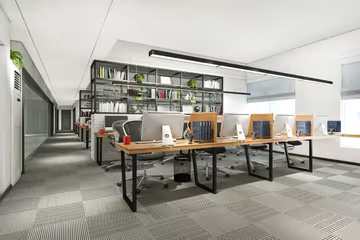
How to Price Your Office Space Competitively
Setting a market-aligned price for your flexible office space is a critical, ongoing strategic decision. The core goal for every property provider is to maintain high occupancy and maximize net profit. Price your space too high, and you risk extended vacancies; price it too low, and you sacrifice potential revenue.
The modern office space market is defined by a decisive shift toward flexible, hybrid-first models, where tenants demand adaptability and value. This reality requires providers to move beyond static, single-rate pricing to adopt a diverse, dynamic set of pricing strategies. Successfully navigating this market requires a data-driven approach, comprehensive competitive benchmarking, and a clear understanding of how your property's value-add features justify your asking price.
In this office space pricing guide, you will discover the foundational lease structures, learn how to execute strategic market benchmarking, and explore advanced, value-driven pricing models to optimize your revenue streams. Let's dive in.

Unlocking Success: How to Get Clients for Coworking Space in Singapore
Running a successful coworking space in Singapore entails more than simply offering a well-designed workspace. You must know the best strategies to attract a consistent flow of clients who appreciate the distinctive advantages of your space to flourish in the competitive Singaporean market.
At this point, maybe you’re asking yourself how to get clients for coworking space. Well, there are many effective strategies and actionable tips aimed at attracting clients and nurturing a thriving community within your coworking space.
Without further ado, let’s discover how to differentiate your space from competitors, effectively market your offerings, and cultivate a vibrant community that fosters growth and success. Get ready to unlock the secrets of how to get clients for coworking space!