Pricing Guide for Office Spaces in Australia 2026

Pricing Guide for Office Spaces in Australia 2026

Written by: Rick Kamikura

Last Update: 16 March, 2026Read: 5 minutes
When planning to rent an office space in Australia, the first question most businesses ask is: How much does office space cost in Australia? The median price to rent a space in Australia is currently $650-$660 per month, but there is no single fixed rate.

Pricing depends on a combination of factors, including location, building grade, fit-out quality, team size, and the type of workspace you select. Prime CBD offices with luxury amenities sit at the higher end, while suburban and regional options are generally more affordable.

To help you budget with confidence, we have compiled the Australia Office Space Price Guide 2026, powered by live market data. This guide breaks down median desk rates, city and state-level pricing, calculation methods, and affordable alternatives, giving you the clearest picture of what office rental costs look like before you commit to a lease.

Breaking Down Flexible Office Space Prices Across Australia in 2026
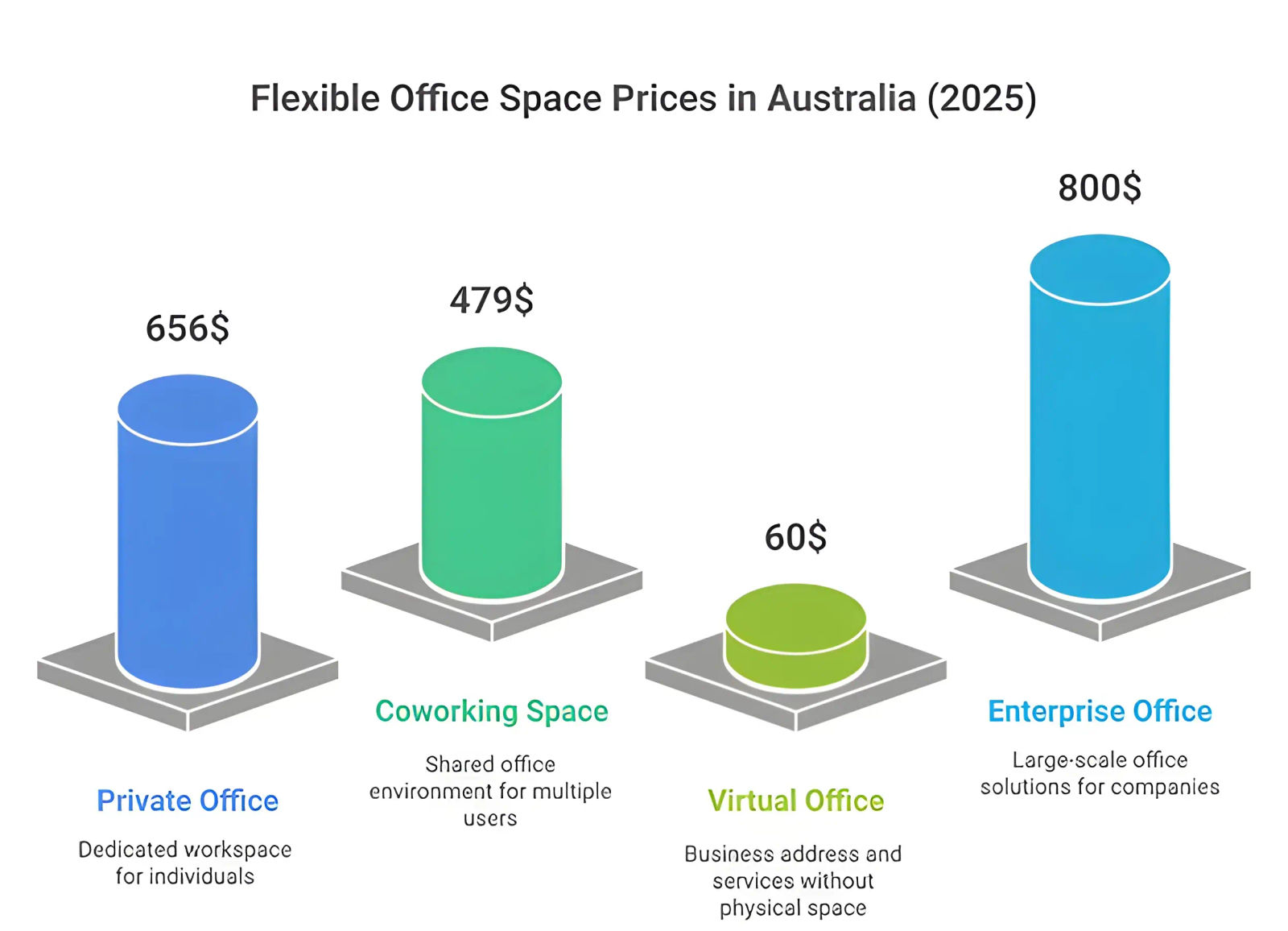
Flexible office space continues to expand, with 144,430 sqm of total flexible floorspace available nationwide and a total desk capacity of 27,815 desks. The data shows a clear divide between premium private offices and more affordable coworking options.

The points below highlight the ongoing office space prices in Australia for 2026.
  • A median monthly private office cost in Australia is $656 per person, reflecting demand for enclosed, fully serviced suites.
  • The median monthly coworking space cost in Australia is $479 per person, offering a budget-friendly option for freelancers and startups.
  • A median monthly virtual office cost in Australia is $60 per person, making it an ideal option for businesses that require only a premium business address and mail handling services.
  • For large companies, the median enterprise office rate is $800 per person/month, providing customised fit-outs and branding.

Australia’s flexible office market is showing a widening gap between affordable and premium offerings. Private offices and enterprise offices command higher rates due to enclosed layouts, advanced amenities, and customisation, making them attractive for corporates seeking privacy and scalability.

In contrast, coworking desks and virtual offices remain cost-effective choices for freelancers, startups, and remote teams who prioritise flexibility over exclusivity. This tiered pricing structure highlights how the sector is evolving to cater to both ends of the business spectrum. Looking ahead to 2030, this divide is likely to deepen further.
Flexible Office Space Prices Across Australia in 2026
Flexible office space cost varies according to space type; therefore, it is expected to change in future based on different circumstances and factors. Premium offices in Sydney and Melbourne CBDs are expected to see sustained price growth, driven by limited supply and rising demand for high-quality spaces. Meanwhile, coworking and virtual spaces will expand rapidly across suburban hubs and regional centres, offering affordable alternatives for businesses seeking to decentralise.

The market will increasingly operate on a dual-track model, featuring luxury CBD offices on one end and widespread, flexible, low-cost options on the other. This model enables businesses to scale up or down according to their strategic and financial needs.

Flexible Office Prices by Capital City in Australia (2026)

Australia’s flexible office market continues to mature, with more than 158,000 sqm of fully fitted workspace available nationwide as of March 2026. Unlike traditional leases, these offices are plug-and-play, allowing businesses to move in immediately with minimal setup.

Sydney remains the priciest market, particularly for small teams of 1–4 desks, where costs range from $950 to $1,050 per person per month. By comparison, Melbourne CBD office rental rates sit in the mid-range, with private offices averaging $700–$800 per desk, making it an attractive option for businesses seeking central locations at more manageable prices.

In Brisbane, office space pricing remains highly competitive. Small to mid-sized teams can expect rates ranging from $600 to $640 per person, while larger teams benefit from some of the most affordable options in the country, with desks available for as low as $300 to $500 per month. Perth commercial office lease costs are steadily rising, averaging $715–$800 for small teams and $649–$800 for mid-sized groups, reflecting increasing demand in the west.

For cost-conscious businesses, Adelaide offers some of the most affordable office space nationwide, with desks starting at $540 per month and rarely exceeding $850, depending on team size. Similarly, Canberra office space prices are budget-friendly for small groups (starting at $489 per desk) but increase for larger teams, where premium office suites can cost up to $1,044 per person per month. Hobart continues to offer ultra-low-cost options, with desk rates ranging from $500 to $550, appealing to startups and freelancers who seek value without compromising on professionalism.

While these are city-specific medians, the actual price depends heavily on the location within the city (CBD vs. suburban), the type of space (hot desk vs. private office), and the size of the team.
 

City

Small Teams (1–4 desks)

Mid Teams (5–15 desks)

Larger Teams (16+ desks)

Sydney

High ($950–$1,050 pp)

High ($1,000+ pp)

Moderate ($700–$850 pp)

Melbourne

Mid ($700–$800 pp)

Mid ($700–$800 pp)

Affordable ($650–$665 pp)

Brisbane

Affordable ($600–$640 pp)

Affordable ($600–$628 pp)

Budget ($300–$500 pp)

Perth

Mid ($715–$800 pp)

Mid ($649–$800 pp)

Adelaide

Budget ($540–$850 pp)

Budget ($600–$850 pp)

Canberra

Budget ($489–$656 pp)

Higher ($792–$1,044 pp)

Hobart

Budget ($500–$550 pp)

What are the Cheap Office Space Options in Australia?

High-cost CBD towers no longer dominate Australia’s office market. Regional towns, suburban hubs, and coastal centres are now offering some of the most affordable coworking options in the country.

In Sydney, small private offices can cost around $950–$ 1,050 per desk per month, while Melbourne averages $ 700–$ 800 for similar setups. By contrast, regional and suburban coworking hubs offer desks for as little as $200 per month. These affordable options appeal to startups, freelancers, and hybrid workers who seek cost savings without compromising professionalism.

The affordability comes from lower commercial rents and government-supported innovation programs that help subsidise space outside capital cities. Despite the lower price tag, these offices still offer modern facilities, including high-speed internet, meeting rooms, breakout areas, and shared amenities. With hybrid work enabling more professionals to live beyond CBDs, regional coworking hubs are quickly becoming a wise choice for both financial and lifestyle reasons.

Suburban Coworking Hubs

Suburban markets are rising as cost-effective competitors to CBD offices. Locations like North Sydney, Parramatta, and Chatswood now offer flexible memberships starting at $200–$300 per month for hot desks, which is significantly less than the average in the CBD. These hubs come with essential features, including secure WiFi, meeting room access, shared kitchens, and breakout spaces, allowing businesses to operate efficiently at a fraction of the cost of city-centre locations.

Beyond affordability, suburban hubs reduce the need for long commutes while fostering local networking opportunities. For hybrid professionals working a few days a week in the office, they provide a professional environment close to home, combining convenience with savings.

Regional and Coastal Coworking Spaces

Regional and coastal areas are pushing affordability even further. In towns like the Sunshine Coast, Gold Coast, Byron Bay, and Ballarat, coworking spaces often start at under $200 per month, making them some of the most affordable in the country. Many of these spaces are supported by councils and government-backed programs designed to stimulate entrepreneurship and attract remote professionals.

In addition to prioritising community engagement and functionality over luxury design, these hubs deliver the essentials, reliable internet, collaborative environments, and meeting facilities. For freelancers and small businesses, the combination of ultra-low costs and the lifestyle benefits of regional living creates a compelling alternative to the high costs of CBD offices.

Affordable Flexibility Beyond the CBD

Australia’s flexible office market has expanded far beyond high-cost CBD towers. From suburban hubs to coastal innovation centres, businesses of all sizes can now find affordable options that deliver quality facilities and collaborative communities.

For freelancers, startups, and hybrid teams, these spaces offer an opportunity to reduce overhead without compromising professionalism, demonstrating that innovative, flexible work doesn’t have to come at a premium price.

Australia Flexible Office Space Market Analysis (2025-2030)
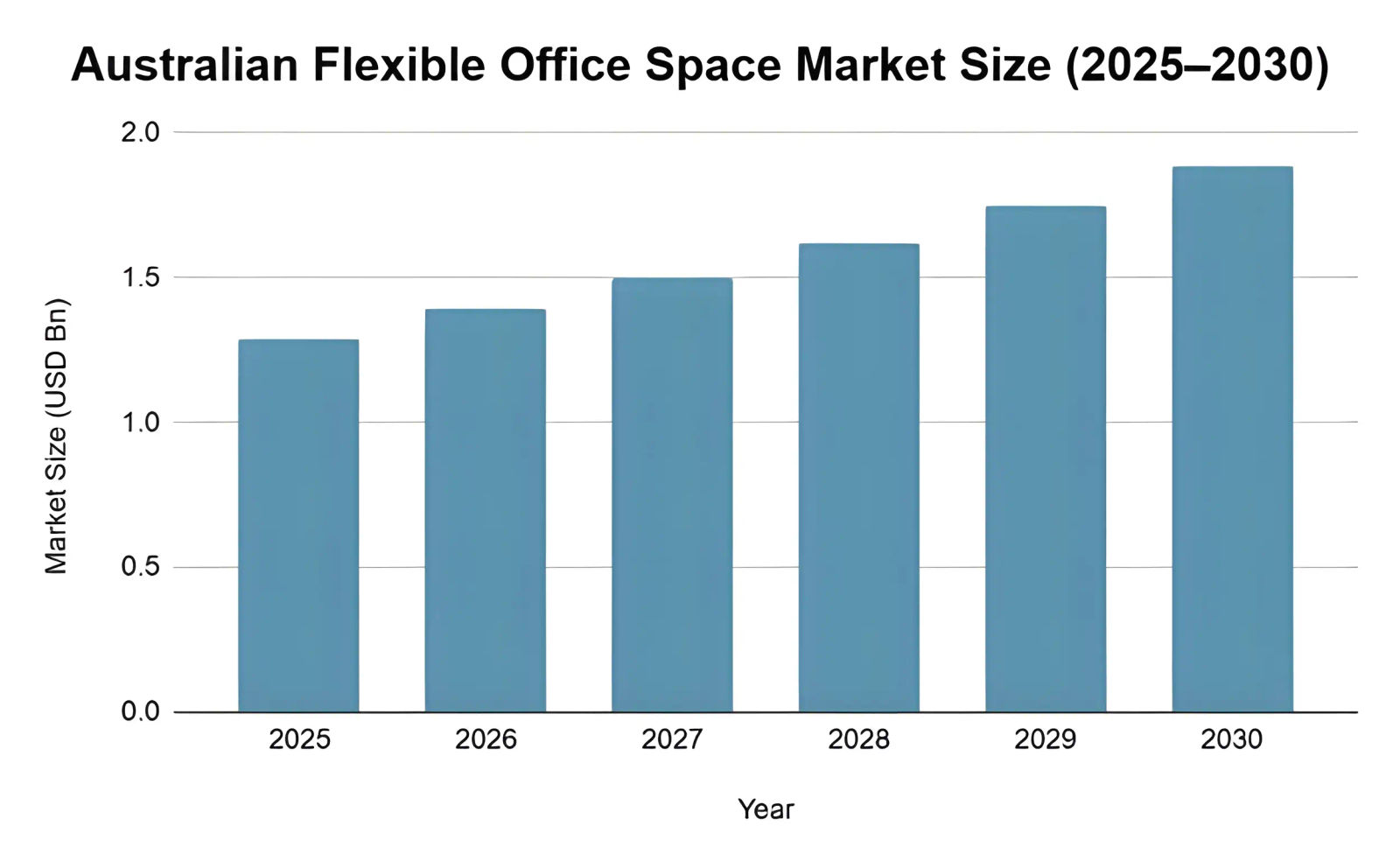
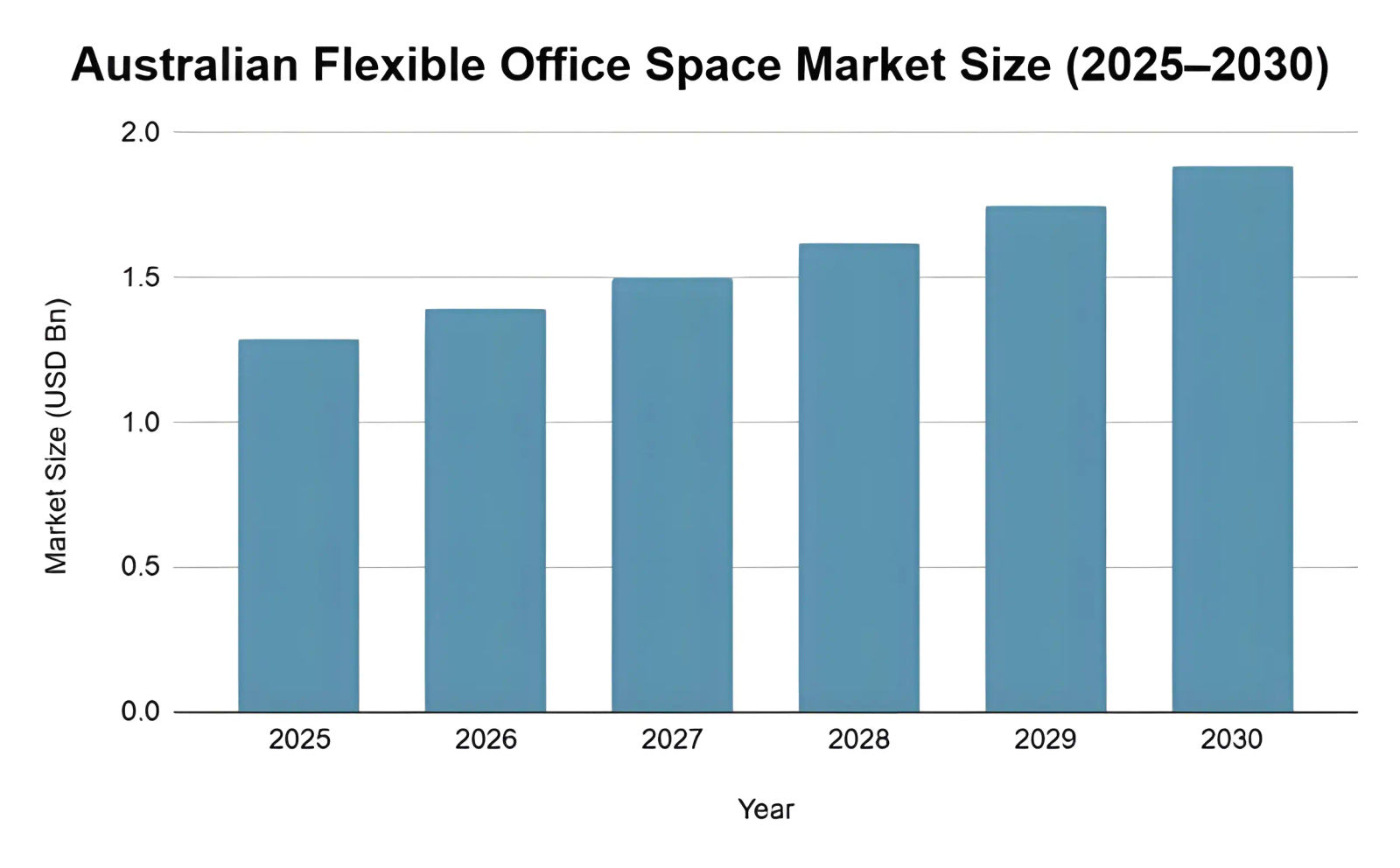
According to a recent report by Mordor Intelligence, Australia’s flexible office space market is estimated to be worth USD 1.29 billion in 2025, and projections suggest it will reach USD 1.89 billion by 2030, with a compound annual growth rate (CAGR) of approximately 7.84%.
image
Hybrid work models are reshaping demand. Businesses are increasingly opting for flexible workspaces that cater to both collaborative and remote work styles. In Sydney, flexible desk rates for small office setups have increased to around $1,000 per desk/month, especially in premium areas. Meanwhile, in Melbourne, enterprise-sized office rates (for larger teams) have eased by roughly 10% with median rates around $725 per desk in many precincts.

The market is showing signs of stabilisation: the national median desk rate has held steady near $667 per desk/month, despite economic headwinds. One notable trend is the strong demand for smaller office configurations (1–15 desks), while availability for larger suites (50+ desks) is shrinking in many CBDs.

Premium locations, such as Barangaroo in Sydney, command even higher rates (e.g., approximately $1,301) per desk/month. Operators are responding to the shifting supply and demand by enhancing offerings, such as better amenities, shorter lease terms, and more flexible layouts.
Australian Flexible Office Space Market Size (2025–2030)

Rental Rates of Office Hub’s Workspace Partners in Australia

Australia’s flexible office market is diverse, offering options that range from affordable desks to high-end private offices in landmark buildings. Our key partners, including Servcorp, Compass Offices, and Regus, offer businesses the flexibility to select spaces that suit their specific needs in terms of size, budget, and operational requirements.

Below is a breakdown of their rental rates along with example locations.

Servcorp

Servcorp
Servcorp delivers premium office solutions across Australia, with monthly rental prices ranging from $144 to $18,750. Known for prestigious addresses and first-class amenities, Servcorp is ideal for businesses seeking a professional presence in iconic buildings.

Examples of Servcorp office spaces in Australia:

Compass (Australia)

Compass (Australia)
Compass Offices offers flexible and cost-effective workspace solutions, with monthly rental prices ranging from $83 to $12,002 per month. Their offices are strategically located in major business districts, making them an attractive choice for SMEs and corporates seeking accessibility and professional services.

Examples of Compass Offices in Australia:

Regus (Australia)

Regus (Australia)
Regus is one of the largest workspace providers in Australia, with rental prices starting from $61 up to $80,892 per month. Their extensive network spans major cities and regional hubs, offering a range of services from coworking desks to fully serviced offices with global business support.

Examples of Regus office spaces in Australia:
Disclaimer: The prices mentioned above are estimates based on current market data and are subject to change without notice. The actual cost will depend on factors such as location, the specific size of the office, amenities, and the length of the lease term. For a precise quote, it is best to contact Office Hub’s flexperts.

Key Drivers Shaping Office Rental Rates in Australia

Australia’s office rental market is being reshaped by shifting workstyles, new landlord-operator partnerships, and changing tenant expectations. From hybrid schedules influencing space demand to the rise of premium CBD hubs and suburban growth corridors, several key factors now play a central role in determining office space cost in Australia.

Details of key drivers shaping office rental rates in Australia are presented below.

Hybrid Work Reshaping Office Needs

The rise of hybrid schedules has permanently changed workplace culture across Australia. Companies now prefer flexible memberships over long-term leases, allowing them to adjust their space use depending on the number of employees who come into the office each week.

Landlords Adopting Flexible Models

In high-profile business districts like Sydney’s CBD and Collins Street in Melbourne, landlords are teaming up with coworking operators. By offering flexible floors within traditional office towers, they attract tenants seeking agility while reducing vacancy risks.

Rise of Premium Coworking in CBDs

With demand outpacing supply in central locations, operators are moving toward high-end offerings. Many CBD coworking hubs now feature hospitality-inspired services, sleek interiors, wellness programs, and event-ready venues, reflected in higher rental rates.

Growth in Suburban and Secondary Markets

As CBD prices rise, more businesses are opting for suburban hubs like Parramatta, Richmond, and North Sydney, as well as regional hotspots such as the Gold Coast. These areas provide professional workspaces closer to home and often at more affordable rates.

Community and Brand Strength as Differentiators

Not all coworking operators survive in Australia’s competitive landscape, but those that build strong communities and a distinct brand identity thrive. For many members, the sense of connection and belonging is just as valuable as the workspace itself.

How Office Space Costs are Calculated in Australia?

To gain a better understanding of how office space costs in Australia change, it is essential to know how they are calculated. For traditional office leases, rent is calculated by multiplying the price per square metre by the office size. For example, a 60 m² office in the Sydney CBD at $1,000/m² would be approximately $5,000 per month, plus GST and additional costs such as utilities, internet, and land tax. Fit-outs and furniture are also paid separately, making expenses less predictable.

With flexible office spaces, costs are calculated on a per-desk basis. If a desk is $800 per person and you need six, your monthly fee is $4,800. This usually includes meeting rooms, WiFi, kitchens, and other shared facilities. Since you only pay for the desks you need, flexible spaces often provide better value and more straightforward budgeting.

The chart below highlights the key differences between traditional office leasing and flexible office space in Australia:
 

Aspect

Traditional Office Lease

Flexible Office Space

How it’s calculated

Rent per m² × office size

Cost per desk × team size

Example

60 m² × $1,000/m² ÷ 12 = $5,000/month + extras

$800 × 6 desks = $4,800/month

Extra costs

Outgoings, utilities, internet, land tax, fit-out

Usually included in membership

Amenities

Must be set up and paid for separately

Shared (WiFi, meeting rooms, kitchens, etc.)

Flexibility

Locked into long leases

Month-to-month or short-term contracts

Verdict: Flexibility at Every Price Point

Australia’s office rental landscape is becoming increasingly diverse, with affordable suburban and regional coworking spaces emerging as practical alternatives to high-priced CBD offices. For many businesses, evaluating office space cost in Australia is no longer just about square metres but also about flexibility, community, and value-added services. These hubs not only lower overheads but also nurture collaboration, entrepreneurship, and stronger local business networks, giving companies more freedom to scale and adapt at every price point.

For anyone navigating this diverse market, Office Hub is the ideal partner. With access to thousands of listings nationwide, live pricing data, and expert local advice, Office Hub helps businesses compare options, arrange tours, and secure the proper workspace, whether it is a Sydney skyscraper or a coastal coworking hub.

Frequently Asked Questions (FAQs)

The median cost to rent a space in Australia is currently $650 to $660 per person per month. The price varies widely depending on the location, amenities offered, and type of space.
Traditional office leases in prime CBD towers can run into the hundreds of dollars per square metre annually, plus outgoings and fit-out costs. By contrast, flexible offices such as coworking and serviced offices offer monthly memberships starting from $200, making them more budget-friendly for small businesses and freelancers.
As of 2025, the average prime office rent per square metre is approximately $1,200–$1,500 annually in the Sydney CBD, $700–$800 in the Melbourne CBD, and significantly lower in suburban and regional markets, often ranging from under $400 to $400 per square metre annually.
A small private office in Sydney CBD typically costs around $950–$1,050 per desk/month, making it the most expensive market in Australia. In Melbourne CBD, similar setups average $700–$800 per desk/month, offering slightly more affordable options.
Serviced offices generally start from A$500 per desk/month in suburban markets and range up to $1,200 in CBD locations with premium amenities. Pricing includes furniture, internet, cleaning, utilities, and access to shared facilities, making them cost-effective compared to traditional leasing.
Key factors include location, building grade, office type, amenities, demand and supply, and lease flexibility. Premium CBD offices command higher prices due to prestige and proximity, while regional and suburban hubs are cheaper thanks to lower commercial rents and council-backed initiatives.
Sydney CBD consistently ranks as the most expensive office market in Australia. Premium office space in this area costs more than in Melbourne, Brisbane, or Perth, driven by strong corporate demand and limited availability of Grade A office towers.
Rick Kamikura
Rick Kamikura
ABOUT THE AUTHOR
Rick Kamikura
Rick Kamikura is a young genius who manages and expands enterprise accounts across the APAC region. With a knack for driving growth, Rick collaborates with global teams (US, UK, SG, AUS) to forge international partnerships and strengthen regional ties.

We are Australia's No. 1 marketplace for serviced, coworking, and shared office space.

Connect with our local experts for flexible workspace solutions across Australia. Get personalized recommendations, arrange tours, and secure the best deals — all at no cost.


Office Hub team memberOffice Hub team memberOffice Hub team memberOffice Hub team member

Talk to our Experts directly

1300 770 200

Latest News

Explore trends, data, and tips shaping Australia’s dynamic office market

Breaking New Ground: Inventory Integrations That Change Everything

Breaking New Ground: Inventory Integrations That Change Everything

In the flexible workspace game, speed and accuracy matter. Outdated listings, incorrect availability, and manual updates don’t just slow you... Read more
Rebecca Philipp11 May, 2026
Pricing Guide for Office Spaces in Australia 2026

Pricing Guide for Office Spaces in Australia 2026

When planning to rent an office space in Australia, the first question most businesses ask is: How much does office space cost in Australia?... Read more
Rick Kamikura16 March, 2026
Managed vs Traditional Office Spaces in Australia: Which One is Right for Your Business

Managed vs Traditional Office Spaces in Australia: Which One is Right for Your Business

Traditional and managed office spaces are popular and viable options that Australian businesses consider to run their operations. However, t... Read more
Rick Kamikura27 February, 2026
Office Hub Launches First Strategic Partnership in the Netherlands, Marking a Major Milestone in Global Expansion

Office Hub Launches First Strategic Partnership in the Netherlands, Marking a Major Milestone in Global Expansion

Office Hub, the global flexible workspace advisory and technology platform, today announced the launch of its first licensed market in the N... Read more
Rebecca Philipp13 January, 2026
A Guide to Employee-Centric Flexible Office Amenities That Actually Matter

A Guide to Employee-Centric Flexible Office Amenities That Actually Matter

The office is no longer just a place to execute tasks; it is a powerful tool for recruiting, retention, and performance. According to WOW Re... Read more
Andrew Beck8 January, 2026
Coworking Space Cost in Australia: A Comprehensive Guide (2026)

Coworking Space Cost in Australia: A Comprehensive Guide (2026)

Coworking spaces have become a popular choice for businesses in Australia, offering numerous advantages such as flexibility, cost-efficiency... Read more
Rebecca Philipp7 January, 2026
Short-Term vs. Long-Term Office Leases: Which One is Better for Your Business?

Short-Term vs. Long-Term Office Leases: Which One is Better for Your Business?

Selecting the right lease term has become a crucial element of modern business. It is not only about getting a workspace anymore; it is abou... Read more
Andrew Beck6 January, 2026
Handling Shared Space Operations: A Guide for Multi-Tenant Management

Handling Shared Space Operations: A Guide for Multi-Tenant Management

Managing a shared workspace is about creating an environment where every tenant feels valued, productive, and supported. When operations run... Read more
Andrew Beck6 January, 2026
How to Make Your Space Eco-Ready and Marketable for Tenants

How to Make Your Space Eco-Ready and Marketable for Tenants

Sustainability is no longer a niche trend in commercial real estate; it is a core expectation for tenants and investors alike. An eco-ready ... Read more
Angeline Suriaatmaja6 January, 2026
What is an Office Pod and How Can It Improve Privacy?

What is an Office Pod and How Can It Improve Privacy?

In the modern Australian workplace, where open-plan layouts dominate from Sydney’s CBD to Brisbane’s tech hubs, a common challenge has emerg... Read more
Miles Anderson5 January, 2026
The Future of Flexible Workspaces: Insights for Space Providers

The Future of Flexible Workspaces: Insights for Space Providers

The flexible workspace industry stands at a critical juncture. The shift to permanent hybrid models is a foundational change driving global ... Read more
Angeline Suriaatmaja12 December, 2025
The Importance of Flexible Lease Terms for Attracting Modern Tenants

The Importance of Flexible Lease Terms for Attracting Modern Tenants

The rental market has fundamentally changed. Today's tenants, driven by dynamic careers and lifestyle needs, are no longer content with ... Read more
Rebecca Philipp12 December, 2025
How to Price Your Office Space Competitively

How to Price Your Office Space Competitively

Setting a market-aligned price for your flexible office space is a critical, ongoing strategic decision. The core goal for every property pr... Read more
Angeline Suriaatmaja11 December, 2025
Is a Flexible Office Right for You? Financial Factors to Consider

Is a Flexible Office Right for You? Financial Factors to Consider

Australian businesses are navigating a workplace revolution. With hybrid work becoming the norm, teams expanding or contracting quickly, and... Read more
Daniel Lange10 December, 2025
Designing Your Perfect Workspace: Layout Tips for Productivity and Culture

Designing Your Perfect Workspace: Layout Tips for Productivity and Culture

Congratulations ! Moving into a new office is a significant milestone for any growing startup. Now that the boxes are unpacked and the WiFi ... Read more
Daniel Lange2 December, 2025