Canada Office Space Cost 2025 | Complete Pricing Guide

Canada Office Space Cost 2025 | Complete Pricing Guide

Written by: Miles Anderson

Last Update: 1 October, 2025Read: 7 minutes
Are you an entrepreneur looking to rent an office space in Canada but feeling overwhelmed by the various pricing options?

Don’t worry! We have got you covered. This Canada office space pricing guide breaks down everything you need to know so you can rent the best office space without breaking your bank.

From average office space cost in Canada and cost breakdown by region and office space type, to the factors that influence pricing, market trends, and insider tips, we have compiled all the details in one place.

By the end, you will know exactly what to expect, how to spot the best deals, and how to avoid overpaying.

Leave all other chores, sit back, and let’s dive into Canada’s office rental costs together.

How Much Does it Cost to Rent Office Space in Canada in 2025?

Prices of office spaces in Canada vary widely depending on the city, location, and type of workspace you choose.

On average, the cost to rent office space in Canada ranges between CAD $18 - $45 per square foot annually, depending on the city and building grade.

Prime business hubs such as Toronto and Vancouver fall on the higher end of the spectrum, while secondary markets like Calgary, Ottawa, and Edmonton generally offer more affordable options.

For small private offices, businesses can expect to pay around CAD $600 to $1,200 per month, while larger team spaces or premium downtown locations may cost significantly more.

Understanding the per-square-foot price and average office space costs in Canada helps entrepreneurs and companies plan more effectively and avoid unexpected expenses.

Region-Wise Breakdown of Office Space Prices in Canada (2025)

Office space costs vary a lot across Canada, depending on the city and whether you’re downtown or in the suburbs. Some markets, such as Vancouver and Toronto, command premium rents, while others, including Calgary, Ottawa, and Montreal, offer more affordable options. Here’s a closer look at how much you can expect to pay in different regions.

Flexible office rents across Canada vary dramatically depending on the city and if you are looking downtown or in the suburbs. To make things easier, here is how the markets stack up.

1. The Most Expensive Markets

  • Vancouver tops the list, with downtown Class A offices averaging approximately $45.50 per square foot annually (CBRE, 2025). Suburban offices are significantly cheaper, at roughly $20–30 per square foot, which is almost half the price of downtown offices.
  • Toronto follows closely, with downtown rents averaging approximately $35.50 per square foot. Suburban A-class offices typically cost $25–30 per square foot, making them a more affordable alternative while still keeping businesses in Canada’s financial hub.

Key Takeaway: If prestige and central access are priorities, Vancouver and Toronto are the go-to markets, but expect to pay premium prices. Suburban locations here can help balance costs without losing connectivity.

2. The Mid-Range Markets

  • Montreal is significantly more affordable, with downtown Class A rents at approximately $18.20 per square foot (CBRE, 2025). However, newer or refurbished buildings can reach $23 per square foot or more, nearly matching suburban refurbished offices at approximately $22 per square foot (Avison Young).
  • Calgary also offers competitive pricing, with downtown Class A offices averaging approximately $ 19.20 per square foot and suburban offices even lower, at $16–18 per square foot.
  • Ottawa exhibits a similar trend, with downtown Class A rents at approximately $19.30 per square foot and suburban Class A rents at approximately $16.40 per square foot (Colliers).
Key Takeaway: Montreal, Calgary, and Ottawa are the value markets. They offer downtown access at less than half the cost of Vancouver and Toronto, with suburban options further reducing expenses.

3. Downtown vs. Suburban Breakdown

  • Downtown: Canada’s priciest downtowns are Vancouver (~$45.5) and Toronto (~$35.5). Mid-tier markets, such as Montreal (~$18.2), Calgary (~$19.2), and Ottawa (~$19.3), sit significantly lower.
  • Suburban: Across all cities, suburban spaces are 20 to $40% cheaper than downtown. In Ottawa and Calgary, suburban Class A office space can be as low as approximately $16 per square foot, while in Vancouver and Toronto, suburban Class A offices typically range from $20 to $30 per square foot.
Key Takeaway: For businesses on a budget, suburban markets across Canada provide strong savings while still offering quality spaces, whereas downtown offices remain the choice for visibility and prestige.

For easy understanding, we present a summarised chart below for comparing office space costs in different regions of Canada in 2025.
 

City

Downtown Class A ($/ft²)

Suburban Typical ($/ft²)

Market Position

Vancouver

~$45.5

~$20–30

Most Expensive

Toronto

~$35.5

~$25–30

Expensive

Montreal

~$18.2 (up to $23+ for new Class A)

~$22 (refurbished Class A)

Mid-Range

Calgary

~$19.2

~$16–18

Affordable

Ottawa

~$19.3

~$16.4

Affordable


Note: Prices vary depending on building grade, lease terms, and location within each city. Downtown towers often command higher rents compared to suburban offices.

Comparison of the Prices of Different Types of Office Spaces in Canada (2025)
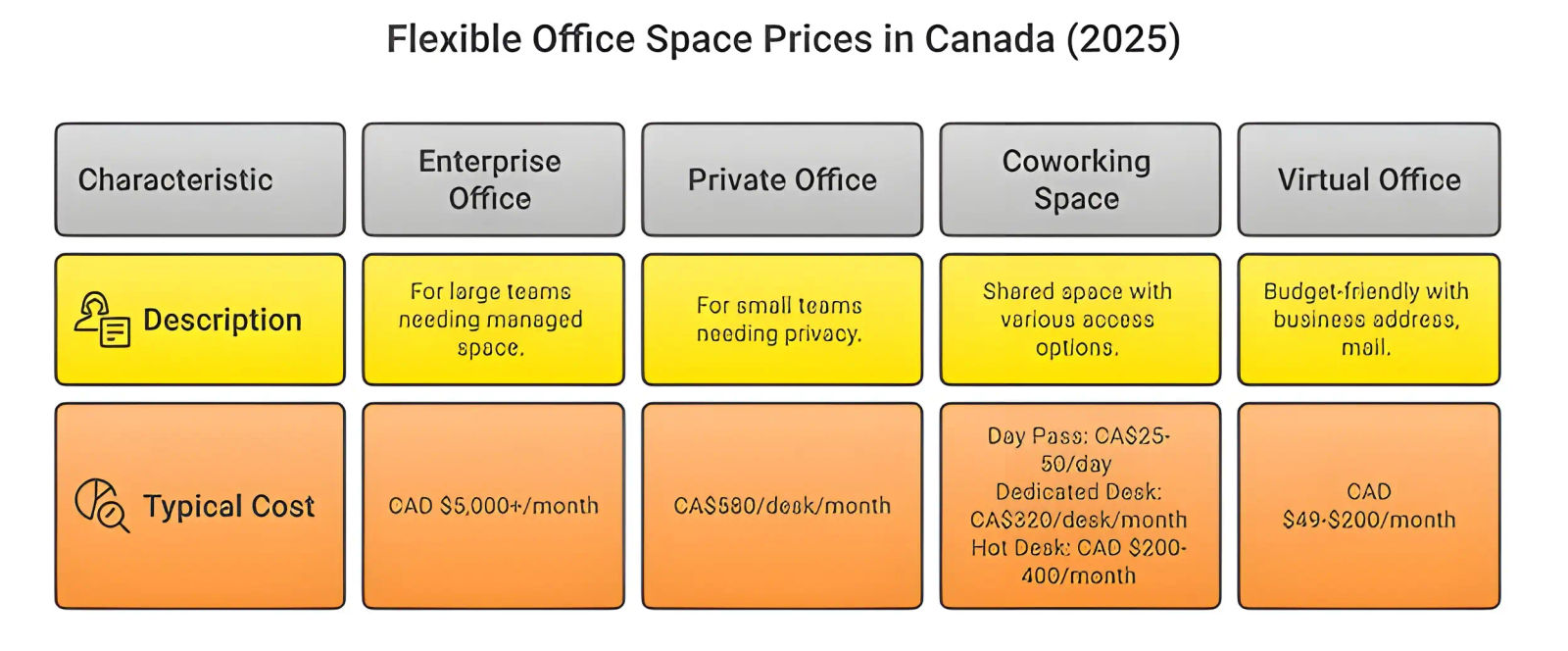
If you are hunting for a quick, all-in monthly payment instead of dealing with complicated per-square-foot math, the flexible office market is your friend.

Here is what you can expect to pay for the main types of flexible office spaces in Canada's major cities this year.
Coworking Space Cost in Canada

Enterprise Offices

Enterprise offices are designed for larger teams of 20 or more employees who need the feel and functionality of a traditional office but want it delivered quickly and fully managed.

The starting price typically begins at CAD $5,000 per month and scales upward depending on the required square footage.

On a per-square-foot basis, enterprise office pricing typically falls within the range of $65 to $85 (gross) annually, which is considered excellent value since it includes utilities, maintenance, furniture, and IT infrastructure—expenses that can add up significantly in a conventional lease.

Why Companies Choose It: Enterprise solutions eliminate hefty upfront construction and fit-out costs while offering full flexibility. Businesses can scale up or down quickly without being locked into rigid 5- or 10-year commitments, making this option especially attractive for fast-growing or project-based teams.

Private Offices

If you are a small business or team that needs privacy and a dedicated, lockable space, a private office within a flexible workspace is your best bet. Remember, these prices usually include all your utilities, fast internet, and office amenities.

Here is the straightforward breakdown of the costs for a private office in 2025:

The National Picture
Generally, the cost of private office space in Canada is CA$580 per desk per month. This is a solid benchmark for smaller markets and suburban areas.
  • Budget Entry Point: If you look in smaller cities, suburban locations, or older buildings, you can often find a one-person private office starting as low as CA$450 per month. This is an excellent deal for freelancers or solo entrepreneurs needing a quiet space.

The Major City Premium 
Office space costs rise steeply in Canada’s largest and most competitive markets, where demand and real estate prices drive rents higher.
  • Toronto: The Cost of private offices in Toronto is around USD $1,657 (≈CA$2,100) per month. This figure is influenced by the city’s overall cost of living.
  • Vancouver: Vancouver follows closely; the cost of private offices in Toronto is around USD $1,270 (≈CA$1,600) per month, which also pushes office rents upward.

By comparison, private offices in smaller Canadian cities or suburban areas are more affordable, often starting from just CA$450–$500 per month for a one-person office. This makes them an attractive option for startups, freelancers, or businesses that don’t need a downtown address.

Coworking Spaces

Coworking spaces typically fall into three major categories: day passes, dedicated spaces and hot desks. 
  • Day Passes: In Canada, day passes generally range from around CA$25 to CA$50 per day. In Montreal, several coworking spaces offer day rates ranging from CA$20 to $30.
  • Dedicated Desks: A “permanent” or dedicated desk in Canada averages around CA$320 per desk per month. For example, dedicated desk memberships in Toronto average about CA$339 per desk per month, while in Halifax they are around CA$330 per desk per month.
  • Hot Desks: Unlimited monthly hot desk plans in Canada typically range from CAD $200 to CAD $400, depending on the city.

Virtual Offices

Virtual offices are the most budget-friendly option. The cost of virtual offices in Canada ranges from CAD $49 to $200 per desk per month. They provide a professional business address, mail handling services, and in some cases, access to meeting rooms. Additional amenities, such as call answering or on-demand workspace access, increase prices.

Canada Flexible Office Space Market Analysis (2025-2030)

If you have been wondering how fast flexible offices are growing in Canada, the numbers might surprise you.

According to Optix, the coworking segment alone is set to nearly triple from $285 million in 2023 to $893 million by 2030. That’s a huge jump, and it reflects just how quickly hybrid work is reshaping where and how Canadians choose to work.

Market Size and Growth

Research from Mordor Intelligence goes even further, estimating that the Canadian Flexible Office Space Market will hit USD 2.19 billion by the end of 2025 and nearly USD 4.74 billion by 2030 with a CAGR of 16.7%.

What is driving this?

Hybrid work policies, the demand for real-time data on how space is being used, and partnership models that give companies the benefits of office space without long-term lease risks.

Even large enterprises, once tied to traditional offices, are now incorporating flexible workspaces into their core portfolios to attract top talent and remain agile.

Quick question for you: If you had the choice, would you opt for a downtown office with a long lease or a flexible setup that allows you to scale up or down as needed?

Key Market Trends

Here’s how the Canada office space market is breaking down:
  • By Type: Coworking led with 49.1% of the market in 2024, but hybrid and virtual offices are catching up fast with a projected 17.85% CAGR through 2030.
  • By Sector: IT dominated at 31.2% market share in 2024, while business consulting and professional services are set to expand the fastest (18.12% CAGR).
  • By End User: Enterprises held 52.3% of the market in 2024, but startups and emerging firms are expected to grow the fastest at an 18.75% CAGR.
  • By Province: Ontario led the pack with 41.1% share in 2024, while Alberta is expected to grow the fastest at 19.10% CAGR up to 2030.

Investment Confidence

One thing’s clear: investors are buying into the trend.

The USD 800 million acquisition of Industrious by CBRE is a strong signal of confidence in Canada’s flexible workspace market. Operators are also making their spaces smarter and greener by adopting tech-enabled services, sustainability certifications, and geographic diversification.

Co-Working Focus

Co-working is still the heart of the flexible workspace movement. According to NextMSC (NMSC), the Canadian coworking market was worth USD 285.1 million in 2023 and will grow to USD 893 million by 2030, at a CAGR of 17.6%.

The appeal? Flexible terms, cost savings, and the creative buzz that comes from working alongside other professionals. Startups love it, but larger firms are also jumping in as part of their hybrid real estate strategies.

Rental Rates of Office Hub’s Workspace Partners in Canada

Finding the right office space in Canada often comes down to balancing cost, location, and the level of service you need. Leading providers, such as Regus, iQ Offices, and HQ, offer a range of options, from flexible coworking desks to fully serviced private offices.

Below is a breakdown of their rental ranges along with example locations to give you a clearer view of what’s available in the market.

Regus (Canada)

Regus (Canada)
Regus remains one of the most well-known names in flexible office spaces worldwide. In Canada, private offices start at around CAD $129 per person per month, while day offices are available from CAD $69 per day.

The examples of Regus office spaces in Canada are:

IQ Offices

IQ Offices
iO Offices bring a boutique-style experience, offering sleek designs and premium facilities. Day offices here start at CAD $99 per day, making them a strong choice for professionals who need modern space on demand.

The examples of iQ Offices in Canada are:

HQ (Canada)

HQ (Canada)
HQ (Canada) offers flexible spaces suitable for diverse teams, with prices starting at CAD $83 per desk per month. This makes it a cost-effective solution for smaller teams or businesses looking to test new markets.

The examples of HQ (Canada) in Canada are:
Interested in renting office spaces in Canada at affordable rates without compromising on quality? Reach out to our flexsperts.

Factors Impacting the Price of Office Spaces in Canada

Several factors influence the price of office spaces in Canada. These include location and accessibility, building grade and quality, workspace type and flexibility, amenities and services, as well as market demand and vacancy rates. 

The key factors that shape pricing in the Canadian office market are outlined below.

Location and Accessibility
Offices in prime business districts, such as Downtown Toronto or Vancouver, command higher rents due to their prestige, visibility, and proximity to corporate hubs. Easy access to public transportation, highways, and airports also adds to the property's value.

Building Grade and Quality
Class A buildings, featuring modern designs, advanced HVAC systems, smart infrastructure, and high sustainability ratings, are priced higher than Class B or C buildings, which often have more basic features.

Workspace Type and Flexibility
Traditional leased offices tend to cost differently compared to coworking spaces, serviced offices, or flexible leases. Flexible options often carry a premium for shorter commitments but reduce upfront costs.

Amenities and Services
On-site meeting rooms, parking, concierge services, fitness centres, and tech support can increase rental rates. Tenants often pay more for convenience and built-in perks.

Market Demand and Vacancy Rates
High demand in cities with low vacancy rates, such as Vancouver, pushes prices upward, while markets with higher vacancy rates, like Calgary, may offer more negotiable terms.
 

Tips to Avoid Overpaying While Renting Office Spaces in Canada

Tips to avoid overpaying while renting office spaces in Canada include conducting market research, considering flexible office solutions, negotiating lease terms, prioritizing needs, and factoring in move-in time.

All the details on how to avoid overpaying when renting office spaces in Canada are presented below.

Research Market Rates Thoroughly
Compare prices across neighbourhoods and building grades to establish a fair benchmark before negotiating. Market knowledge gives you leverage.

Consider Flexible Office Solutions
Coworking and serviced offices may seem pricier per square foot, but they help you save money by covering utilities, furniture, and maintenance, eliminating hidden costs.

Negotiate Lease Terms
Landlords are often open to concessions such as rent-free periods, fit-out contributions, or capped annual increases if approached strategically.

Prioritize Needs Over Extras
Focus on essential features rather than paying for luxury amenities your team may rarely use. Choosing a practical space reduces unnecessary expenses.

Time Your Move Wisely
Entering the market when vacancy rates are high, or during slower leasing seasons, increases your chances of securing favourable rental terms.
 

How to Spot the Best Deal for Renting Office Spaces in Canada?

Understanding the cost of office space in Canada requires a close examination of multiple factors, including location, building grade, office size, lease flexibility, and additional fees.

With prices varying significantly between cities such as Toronto, Vancouver, Calgary, and Montreal, businesses must carefully research and align their choices with their budget and operational needs.

By comparing market options, assessing space requirements, and negotiating effectively, you can secure an office that supports both productivity and growth without overspending.

Since finding the perfect office in Canada can be overwhelming, Office Hub is here to simplify the process. Our flexperts collaborate with businesses of all sizes to explore the market, identify the best-value options, and negotiate terms that align with your objectives.

Contact us today for personalized guidance and discover the ideal office space in Canada at the best possible deal.

Frequently Asked Questions (FAQs)

On average, office space in Canada ranges between CAD $18 and CAD $45 per square foot annually, depending on the city and building grade. Premium downtown Class A offices in Vancouver and Toronto are at the higher end, while Calgary, Ottawa, and Montreal remain more affordable.
Traditional leases look cheaper on a per-square-foot basis, but they come with additional costs, such as utilities, furniture, IT setup, and long-term commitments. Coworking spaces, by contrast, bundle these services into a single monthly fee, making them more cost-effective and flexible.
Beyond rent, businesses should budget for utilities, maintenance fees, insurance, property taxes, cleaning, furniture, and IT infrastructure. In premium downtown towers, operating costs can significantly raise the total expense compared to the listed base rent.
Suburban office spaces are typically 20–40% less expensive than those in downtown cores. For example, Ottawa’s suburban Class A rents hover around CAD $16 per square foot, compared to CAD $ 25 or more downtown. Suburbs are a wise choice for companies that don’t require a central address but still want quality space.
Remote and hybrid work have softened demand for traditional long-term leases, especially in central downtown cores. This has led to higher vacancy rates and, in some cities, more competitive rental pricing. At the same time, coworking and flexible office spaces have surged in demand as businesses seek greater agility.
Virtual offices are the most affordable option.  The average price for a virtual office address in Canada ranges from CAD $49 to CAD $200 per month. Prices rise with premium downtown addresses and additional services, such as call answering or meeting room access.
Yes. While incentives vary by province and city, some programs offer tax credits, grants, or rental subsidies to businesses setting up in targeted development zones or innovation hubs. It’s best to check with local economic development offices for the latest incentives available in your region.

Miles Anderson
Miles Anderson
ABOUT THE AUTHOR
Miles Anderson
Miles Anderson is a sales powerhouse who thrives on versatility and conquers new markets with expertise. With a track record of driving impressive numbers, Miles also ensures to empower the team members to help them evolve, grow, and reach new heights.

We are Canada's No. 1 marketplace for serviced, coworking, and shared office space.

Connect with our local experts for flexible workspace solutions across Canada. Get personalized recommendations, arrange tours, and secure the best deals — all at no cost.


Office Hub team memberOffice Hub team memberOffice Hub team memberOffice Hub team member

Talk to our Experts directly

778 608 5615

Latest News

Explore trends, data, and tips shaping Canada’s dynamic office market

Breaking New Ground: Inventory Integrations That Change Everything

Breaking New Ground: Inventory Integrations That Change Everything

In the flexible workspace game, speed and accuracy matter. Outdated listings, incorrect availability, and manual updates don’t just slow you... Read more
Rebecca Philipp11 May, 2026
Top 8 Shared Office Space Benefits for Small Businesses

Top 8 Shared Office Space Benefits for Small Businesses

Say goodbye to 5 or 10-year lease options and hello to flexibility! In today’s fast-evolving economic climate, a massive, fixed office acts ... Read more
Rick Kamikura23 January, 2026
How to Choose Co-Working Spaces in Canada: A Guide For Pricing, Trends, and Market Growth

How to Choose Co-Working Spaces in Canada: A Guide For Pricing, Trends, and Market Growth

Gone are the days when rigid leases and isolated home offices defined the Canadian workweek. In 2026, coworking spaces have matured into the... Read more
Angeline Suriaatmaja23 January, 2026
Office Hub Launches First Strategic Partnership in the Netherlands, Marking a Major Milestone in Global Expansion

Office Hub Launches First Strategic Partnership in the Netherlands, Marking a Major Milestone in Global Expansion

Office Hub, the global flexible workspace advisory and technology platform, today announced the launch of its first licensed market in the N... Read more
Rebecca Philipp13 January, 2026
A Guide to Employee-Centric Flexible Office Amenities That Actually Matter

A Guide to Employee-Centric Flexible Office Amenities That Actually Matter

The office is no longer just a place to execute tasks; it is a powerful tool for recruiting, retention, and performance. According to WOW Re... Read more
Andrew Beck8 January, 2026
Short-Term vs. Long-Term Office Leases: Which One is Better for Your Business?

Short-Term vs. Long-Term Office Leases: Which One is Better for Your Business?

Selecting the right lease term has become a crucial element of modern business. It is not only about getting a workspace anymore; it is abou... Read more
Andrew Beck6 January, 2026
Handling Shared Space Operations: A Guide for Multi-Tenant Management

Handling Shared Space Operations: A Guide for Multi-Tenant Management

Managing a shared workspace is about creating an environment where every tenant feels valued, productive, and supported. When operations run... Read more
Andrew Beck6 January, 2026
How to Make Your Space Eco-Ready and Marketable for Tenants

How to Make Your Space Eco-Ready and Marketable for Tenants

Sustainability is no longer a niche trend in commercial real estate; it is a core expectation for tenants and investors alike. An eco-ready ... Read more
Angeline Suriaatmaja6 January, 2026
The Future of Flexible Workspaces: Insights for Space Providers

The Future of Flexible Workspaces: Insights for Space Providers

The flexible workspace industry stands at a critical juncture. The shift to permanent hybrid models is a foundational change driving global ... Read more
Angeline Suriaatmaja12 December, 2025
The Importance of Flexible Lease Terms for Attracting Modern Tenants

The Importance of Flexible Lease Terms for Attracting Modern Tenants

The rental market has fundamentally changed. Today's tenants, driven by dynamic careers and lifestyle needs, are no longer content with ... Read more
Rebecca Philipp12 December, 2025
How to Price Your Office Space Competitively

How to Price Your Office Space Competitively

Setting a market-aligned price for your flexible office space is a critical, ongoing strategic decision. The core goal for every property pr... Read more
Angeline Suriaatmaja11 December, 2025
Designing Your Perfect Workspace: Layout Tips for Productivity and Culture

Designing Your Perfect Workspace: Layout Tips for Productivity and Culture

Congratulations ! Moving into a new office is a significant milestone for any growing startup. Now that the boxes are unpacked and the WiFi ... Read more
Daniel Lange2 December, 2025
How to Negotiate the Best Deal on Your Next Office Space

How to Negotiate the Best Deal on Your Next Office Space

What if a few well-planned negotiation tips could significantly reduce your costs and give your business more flexibility? Negotiating your ... Read more
Rick Kamikura1 December, 2025
How Office Hub Helps You Find, Compare, and Rent the Best Workspaces — Stress-Free

How Office Hub Helps You Find, Compare, and Rent the Best Workspaces — Stress-Free

Did you know the traditional process can take up to three months of searching and negotiation? Well, it’s time to cut the chase! Office Hub ... Read more
Andrew Beck1 December, 2025
How to Read an Office Lease Agreement (Without Getting Lost)

How to Read an Office Lease Agreement (Without Getting Lost)

Signing an office lease can feel overwhelming, especially with all the legal jargon, fine print, and different lease types. Whether you’re m... Read more
Daniel Lange1 December, 2025